
-by Carolyn Prouse
FIFA President Gianni Infantino waved to the crowd as Lenovo’s CEO, Yuanqing Yang, stood next to him on a Las Vegas stage, holding up a special edition FIFA 2026 Razr phone to enormous cheers. The ceremony was somewhat of a salve in comparison to the more fascist displays of authoritarian power increasingly associated with hosting this World Cup, from FIFA awarding Trump its first ever Peace Prize, to ICE raids during the 2025 Club World Cup, to FIFA’s participation in Trump’s Board of Peace to “rebuild Gaza.”
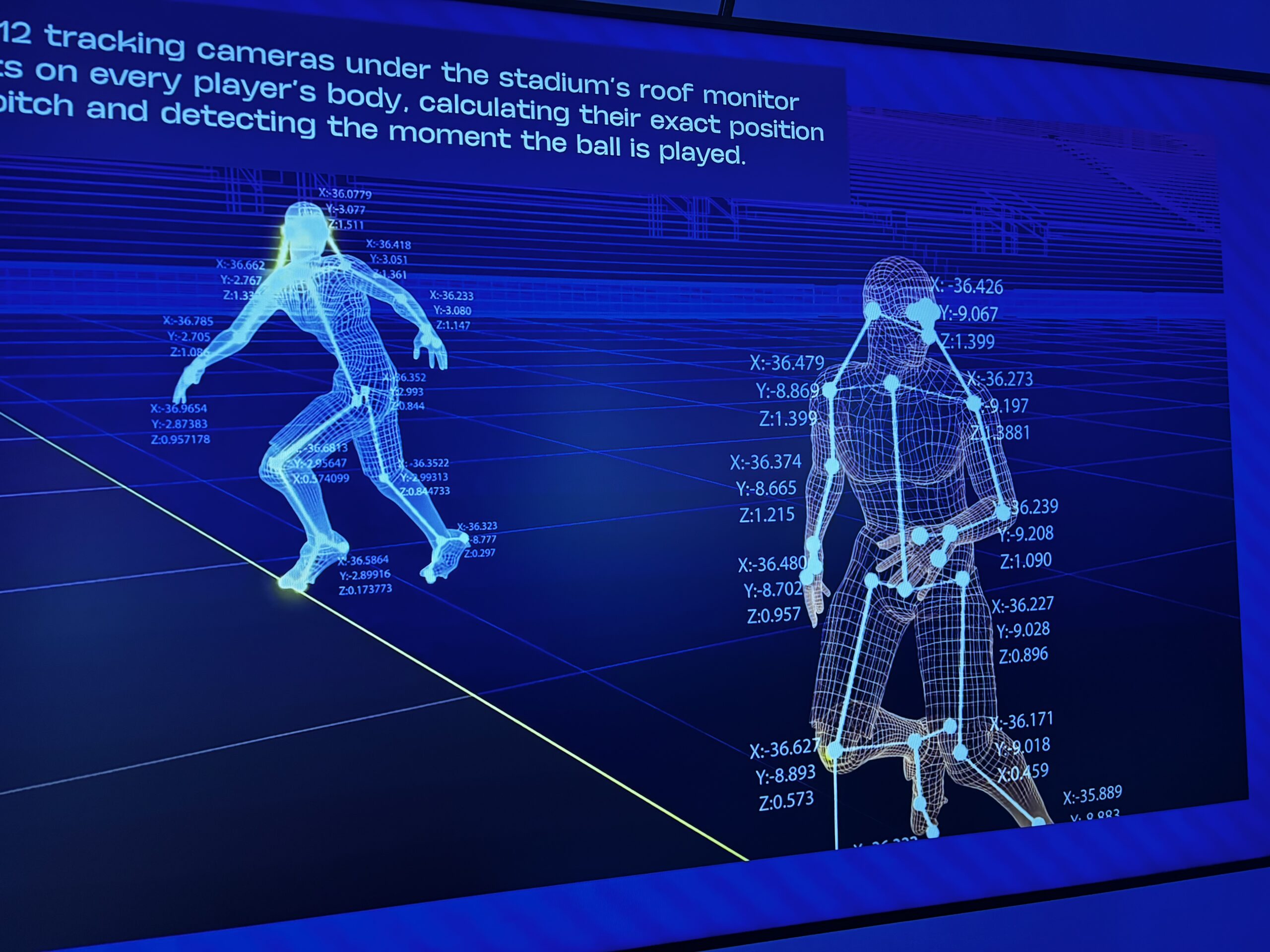
The Silicon Valley-stylized event was to celebrate an agreement between FIFA and Lenovo, the multinational technology company that is helping to provide the “tech backbone” of the FIFA World Cup 2026 (FWC26) hosted across 16 cities and 3 nations. In front of a screen of 3-D digital avatars depicting a footballer in motion, Yang revealed the “Advanced GenAI technology” and “3D assets” the company is providing to “support the efficiency of the decision-making process made by FIFA’s match officials” – decisions that, proven recently, can be reversed by the political bidding of heads of state. Later he introduced the Intelligent Command Center that will “observe” and “respond” to “trends across the tournament’s footprint.”
This partnership is at the centre of FIFA’s Strategic Objectives for 2023-2027 that seek to invest in and leverage digital technology and artificial intelligence (Goal 3). FIFA’s innovations for the FWC26 include Football AI Pro to “democratize” analysis to provide every team access to all match data and analyses; AI-enabled 3D player avatars and digital doubles to feed into Video Assisted Review (VAR) decisions; and AI-stabilized Referee View to stream a smooth Referee Cam video feed for spectators.
While these technological advancements may, on the surface, appear benign in comparison to ICE raids and Gaza rebuilding efforts, what the embedding of digital capitalism through the FWC26 promises to deliver is anything but innocuous: data labeling for football AI is often outsourced to low paid workers in the Global South; and the embrace of all things digital/automatic serves to buttress novel, even technofascist, forms of control and decision-making across our lives – including sport – while evacuating human-centred democracy and connection.
In this mini-series on digital capitalism, technofascism, and the World Cup, I delve into how human agency and democratic forms of decision-making are being evacuated from the game through technologies that make the field of play and sports venue ‘smart.’ From the action on the field, to the smart stadium and the streets beyond, human actions, bodies, and behaviours are being digitized for circulation and profit and for heightened surveillance regimes. I first introduced the relationship between (techno)fascism and the 2026 FIFA World Cup in an infographic you can find here. In this first post, Part I, I consider why a digital capitalist and technofascism lens is useful for understanding how power operates through sport, and cast light on the intimate relationship between sporting and military technologies. In future posts I will scale out to consider the smart stadium and the streets surrounding FIFA’s venues. If you’re interested in chatting more about the contentions I make here, please reach out!
FIFA as Handmaiden to Authoritarianism and Technofascism
The evolving fraternity between FIFA President Gianni Infantino and American President Donald Trump inspired Nick McGeehan of Fairsquare to remark that “FIFA is fast becoming a handmaiden to the authoritarians reshaping a bleak new world order.” But this is not new; as Jules Boykoff writes, FIFA has long had proclivity for near- or real dictatorships, from Mussolini’s 1934 World Cup to promote fascist ideals of a superior national sporting body politic, to the 1978 World Cup in Argentina hosted in El Monumento stadium, a mere 10 minute walk from where Jorge Rafael Videla’s military junta dictatorship tortured political prisoners. FIFA’s preference for authoritarian political regimes makes sense: forcing through the Associations’ World Cup regulations in democratic nations can be drawn out and messy. When FIFA awards the tournament to authoritarian regimes, stadiums get built, streets get cleared, and the dollars flow with less friction.
Less obvious are the ways in which FIFA is not only partnering with authoritarian governments, but are (with their sponsors) reproducing tech-driven forms of inequality, policing, and even fascism, through the collection and analysis of Big Data across all parts of the game, from algorithms determining if the ball crossed the goal line, to monitoring and nudging fan behaviour, to carving athletes’ bodies and movements into millions of data points for betting and predictions markets. Indeed, FIFA’s tech-washing obscures the deeper, more covert ways in which digital capitalism and fascism are sedimenting their hold over sport, much of which is seeping from the stadium into fans’ everyday lives.
Activists and academics are turning to the notion of “technofascism’ to characterize these tendencies of digital capitalism in an increasingly authoritarian West. The term is used to capture how digital technologies (of which AI is only the latest “frontier”) can enable fascistic violence through driving racialized violence, fear, and political polarization while concentrating profit in the hands of private tech companies and/or high level government officials. Technofascism is alive when ICE gathers data from Waymos and private door cameras; when social media algorithms program virality and amplify hate messages about minority religious and ethnic groups; and when police forces use third party platforms – such as Palantir’s Gotham – that deploy artificial intelligence across a variety of Big Datasets to predict when and where crime will occur. Fascism, in the Big Data and digital age, is driven, as Belgian philosopher Mark Coeckelbergh puts it, by “data extraction, algorithmic governance, behavioral nudging, and platform monopolization” that undermine democracy and the social good.
And sport – including and especially hypervisible, nationalist-driven sport mega events – provide the political will, financial dollars, and patriotic fervour to test out and entrench technologies that sow such division. In other words, a slice of the long shadow of technofascism resides in the sport stadium, the sporting technologies that bring us the athletes and the game, and securing the field of sporting action. The FIFA World Cup is only one testbed for such experimental technologies, but is one of the most ostentatious, with a terrifying potential shadowed legacy.
Militarized Sport: Hawk-Eye at the World Cup
Perhaps the most obvious way in which sporting technologies can advance violent, even fascist projects is through their intimate ties with the military. Indeed, the history of sporting technology can be told, in part, through a history of the battlefield and its contestation. From ballistic armor in equipment to GPS and drone surveillance system, the sports field is littered with technology developed to surveil, target, and kill those deemed ‘enemies’ to a nation-state.
A recent high-tech manifestation of this closeknit relationship lies in Video Assisted Review (VAR) and the Semi-Automated Offside Technology (SAOT) deployed at recent FIFA tournaments, in including the 2026 FIFA World Cup. SAOT uses artificial intelligence (AI) to track players’ limbs via “10,000 data points on the bodies of all 22 players” and integrates this data with sensor data from Adidas’ and Kinexon’s TRIONDA ball (Lusweti & Odawa 2023) to determine offside lines.
SAOT technology has been developed by Sony subsidiary Hawk-Eye Innovations, a company that provides optical tracking systems with military roots. Hawk-Eye (perhaps most famously deployed in tennis to replace line judges) was first developed in 2001 by the British company Roke Manor Research Limited, which “specialized in developing sensors for military applications” – known, for instance, for a 1995 program called Halo used to locate weaponry noise for peacekeepers in what was then-Yugoslavia. Hawk-Eye is an off-shoot of a fighter pilot training program that applies systems developed to track missiles to balls – using cameras and mathematical equations to determine if a ball crosses a line. The company used similar technology to help guide Beagle 2 to Mars.
Sport scholars point to the anti-human underpinnings of these systems. Hawk-Eye technology does not analyze an image, but instead “relies on a network of…high-speed cameras which capture the ball from different angles at a fast frame rate, feeding the movement into a computer algorithm which then triangulates the position, creating a reconstructed image of the flight path.” In other words, the replays we (and match officials) see are not replays of reality per se, but are digital representations of both reality and mathematical algorithms that have built-in error rates (for tennis, Hawk-Eye has a mean error rate of 2.2mm).
Jesús Manuel Soledad Terrazas argues that the SAOT system in particular is an ostensible black box: decisions once made by humans are offloaded to proprietary technology that now calculates reality, for profit. Why does this matter? When it is technology and not humans making decisions, accountability is lost. And while algorithms are taking hold across many domains, the refrain that sport is “apolitical” normalizes machine decision-making, allowing potentially illiberal modes of governance to seep into our daily lives, undeterred.
To say that VAR and Hawk-Eye technology advance technofascism because of shared military origins and illiberal tendencies can be both true and vacuous. In a world where Western governments fund the military at exorbitant rates while cutting funding to science research and public education, it is no surprise that the military has helped produce the internet and many digital technologies. And when high performance sport has always been haunted by nationalist or eugenicist impulses (i.e. training “able” bodies for military competition) it is no wonder sport and the military are intimate bedfellows.
But these are not just accidental relationships: such contracts and connections create the political economic foundation for technological development in sport, while normalizing new forms of “artificial” decision-making, from the battlefield, to the sports field and well beyond: Roke is a company that has looked to the stars to colonize.
In the next post, I’ll bring us back to earth to consider the smart stadium as living laboratories of digital capitalism. See you there!