
By: Declan Abernethy
Since the 1960s, Atlantan political and business leaders have repeatedly turned to sport to boost the city’s national and global image and solve long running economic issues downtown. In pursuit of such change, these projects, though, came at a great cost and ignored resident pushbacks. In 1966, 948 families in the Rawson-Washington Project were displaced so Atlanta could build a stadium, land a baseball team, and become a major league city. Three decades later, the city demolished many of those same neighborhoods again and spent hundreds of millions of dollars to build Turner Field, the Georgia Dome, and dorms for the 1996 Olympics.
Although these projects succeeded in making Atlanta not only a major league city but a global metropolis, they occurred in spite, and at the expense, of Atlantans. By 2016, Atlanta had professional football, baseball, and basketball franchises, while many of the communities nearby had a poverty rate of nearly 50%. The following year, the city tore down the 26-year-old Georgia Dome and spent close to a billion public dollars on Mercedes-Benz Stadium across the street. Despite boosters promises, there is little evidence these sport-related developments brought any kind of positive lasting economic impact to everyday Atlantans.
The pattern is old. City leaders sell Atlanta to outsiders, and residents pay the tab — in their homes, livelihoods, and tax funds.
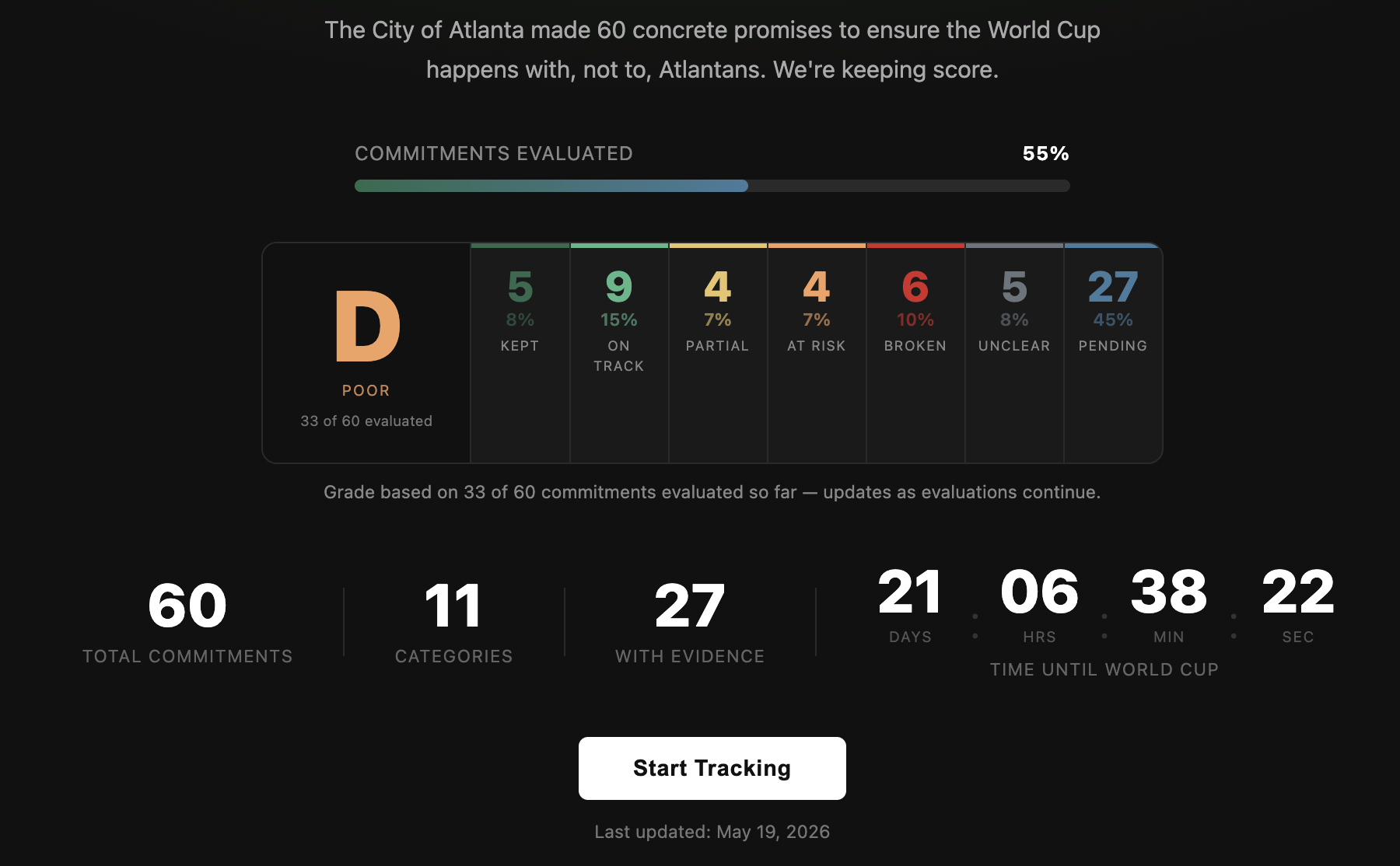
Now the 2026 FIFA World Cup is on our doorstep. Atlanta hosts 8 games. This time around, obligated by new FIFA rules, the city made promises. In early 2026, Atlanta published a Human Rights Action Plan for the World Cup. The Plan includes 60 specific commitments covering labor protections, housing, accessibility, public safety, anti-trafficking measures, and accountability mechanisms. Although the final document, fell far short of the aims of advocacy groups, it’s the first time Atlanta has put something like this on paper ahead of a mega-event. The Human Rights Plan suggests the World Cup can happen “with Atlanta, and not to Atlanta.”
Given Atlanta’s track record regarding sport- related development, the question is whether any of it is real.
The ATL26 Human Rights Plan Promise Tracker attempts to answer that. It tracks all 60 commitments against public evidence: city announcements, news reporting, records, and tips from local advocacy coalition members and residents. Each commitment gets a rating (Kept, On Track, Partial, At Risk, Broken, or Unclear) based on what’s verifiable.
The tracker is updated weekly and will run through December 2026, when the city’s own Post-Games Human Rights Impact Report is due. Every rating includes source links. If you have information about a commitment that isn’t reflected, there’s a tip submission form on the site.
Declan Abernethy is a lecturer at the Georgia Institute of Technology, where he teaches courses on sports, society, and urban Atlanta. He is a member of the Play Fair ATL coalition, a group representing a broad cross section of labor, justice and rights organizations who share the same vision for the World Cup.