Welcome to 2026 World Cup Watch! We are a collaborative effort to build knowledge, connection, and solidarity across communities living with and resisting the harmful impacts of FIFA World Cup 2026 (FWC26) in Canada, Mexico, and the United States.
We’ve come together at a time of growing public outrage at FIFA and the World Cup. Last summer, ICE used the warm-up tournament to the FWC26, the Club World Cup, to seize an asylum seeker by tearing him from his children and sending him back to his “country of origin.” Months later, FIFA bestowed its new “Peace Prize” upon Donald Trump and announced a $75 million investment into Gaza “redevelopment” through the Board of Peace, rendering FIFA’s claims to political neutrality a farce. FIFA is drawing on a global love for football to advance a fascist agenda that fills its pocketbooks as well as that of its geopolitical friends – the U.S. and Israel.
FIFA and its allies see the FWC26 as an opportunity to sharpen fascist tactics across the tournament’s sixteen host cities. This is not new. Sport mega events like the FWC have long served as a “testing ground” for modern forms of surveillance, security, and policing that disproportionately target racialized, immigrant, low-income, and marginalized populations. FWC municipalities and their corporate sponsors weaponize the “feel good” atmosphere of the World Cup to establish city agreements without consultation (dismantling democratic processes), turning public land into high-tech, heavily-fenced areas of FIFA control. Through ‘controlled areas’ (2km radii around stadiums and FIFA Fan Fests), FIFA establishes its own borders wherein local laws are treated as a suggestion. FIFA-fortified police forces across municipalities, counties, states/provinces and countries use advanced technologies and predictive algorithms to monitor and manage those deemed as “threatening” to the commercialized sport spectacle. All of this, while municipal budgets starve public services and funnel public dollars into the protection of private interests.
Our research and organizing efforts also take aim at how the World Cup uproots communities — sometimes through direct demolition, at other times through the indirect violence of gentrification. FIFA requires the “beautification” of landscapes to make host cities “spectacle-ready,” resulting in the suppression of informal, precarious economies and workers. For instance, in past World Cups we’ve seen how surge pricing amplifies exploitation in the gig economy (Uber costs skyrocket while non-unionized drivers remain precarious); anti-trafficking policing harms sex workers; short-term rentals like Airbnb drive up housing costs; integrated “security” units advance tactics of surveillance and “intelligence” sharing; and construction and traffic congestion wreak great environmental destruction.
These horrors help secure billions of dollars for FIFA in broadcast rights and sponsorship contracts, while public wealth is rerouted to private security firms, contractors, and developers. Residents and communities bear all the risks, while FIFA and its partners reap the profits.
Yet the FWC26 is not alone responsible for harms in host cities. Our work instead shows how mega events heighten and crystallize tensions, dynamics, and struggles that often have longer histories in cities and countries. In other words, World Cups often aren’t the primary cause of houselessness, policing, and big data-driven surveillance. Sport mega events do, however, worsen these long-standing urban inequalities and injustices, while introducing policing technologies and expanding gentrification in ways that last long past the final whistle. We see the FWC26 as sharpening the violences of capitalist urbanization, often justified by short construction timelines and patriotic sporting fervour, with interlinked state, corporate, and FIFA interests driving this tide.
In short, we now see FIFA repeating familiar patterns of violence and devastation unfolding across communities in all 16 FWC North American host cities.
At the same time, and in response to these harms, hosting the World Cup galvanizes community networks, activist strategies, and organizers to build coalitions and cities worth celebrating. Because the FIFA World Cup operates through opacity and disconnection, our platform aims to share resources, connect actions in different host cities, and amplify the work already being done across the continent. Only as a collective are we larger and stronger than the imperial and fascist behemoth that is the FWC26.
As an emergent network, together, with you, we hope to build accountability through shared commitments to:
- anti-colonial and anti-fascist organizing;
- environmental justice;
- movements to defund the police;
- analyses underpinned by intersectionality and interlocking systems of power;
- community safety;
- foregrounding lived experience and community struggles; accessibility across different languages, especially English and Spanish; and
- solidarity across affected communities in Canada, United States, and Mexico.
How can you get involved? Our organizing structure is intentional but flexible to respond to the needs of a growing collective and movement. If you, too, are concerned about FWC26-related harms in your community and share our commitments, we invite you to contribute to the communal platform through grounded insights, research, and organizing efforts across a range of formats, including short or long-form written pieces (blog posts, essays, reflections); interviews with organizers, workers, or community members; maps (GIS-based or otherwise) documenting spatial and infrastructural impacts; visual materials (photography, illustrations, data visualizations, artwork, memes); and/or audio or video projects. You can find our official Call for Contributions (EN/ES) here.
We are especially interested in contributions rooted in lived experience and community knowledge, i.e., work that is attentive to local struggles and accessible and accountable to affected communities. We aim to support contributors in producing content that helps build a public-facing, open-access digital platform and virtual archive.
To counter opacity and support the needs of those doing work in real time, we also urgently seek relevant documents and materials for immediate posting, including:
● Host City Agreements
● Stadium contracts and development plans
● Budgets, tax records, and public financing documents
● Grant materials and policy reports
● Community organizing resources, reports, campaign materials, etc.
We welcome contributions from scholars, students, journalists, organizers, artists, and community members, particularly those based in or connected to host cities. Submissions may be made individually or on behalf of collectives and organizations. Pitch a contribution or share materials via FormBricks.
If you are interested in a greater level of involvement through coordinating the network, editing contributions, or organizing/archiving resources, please email us at contact @ 2026worldcupwatch.org
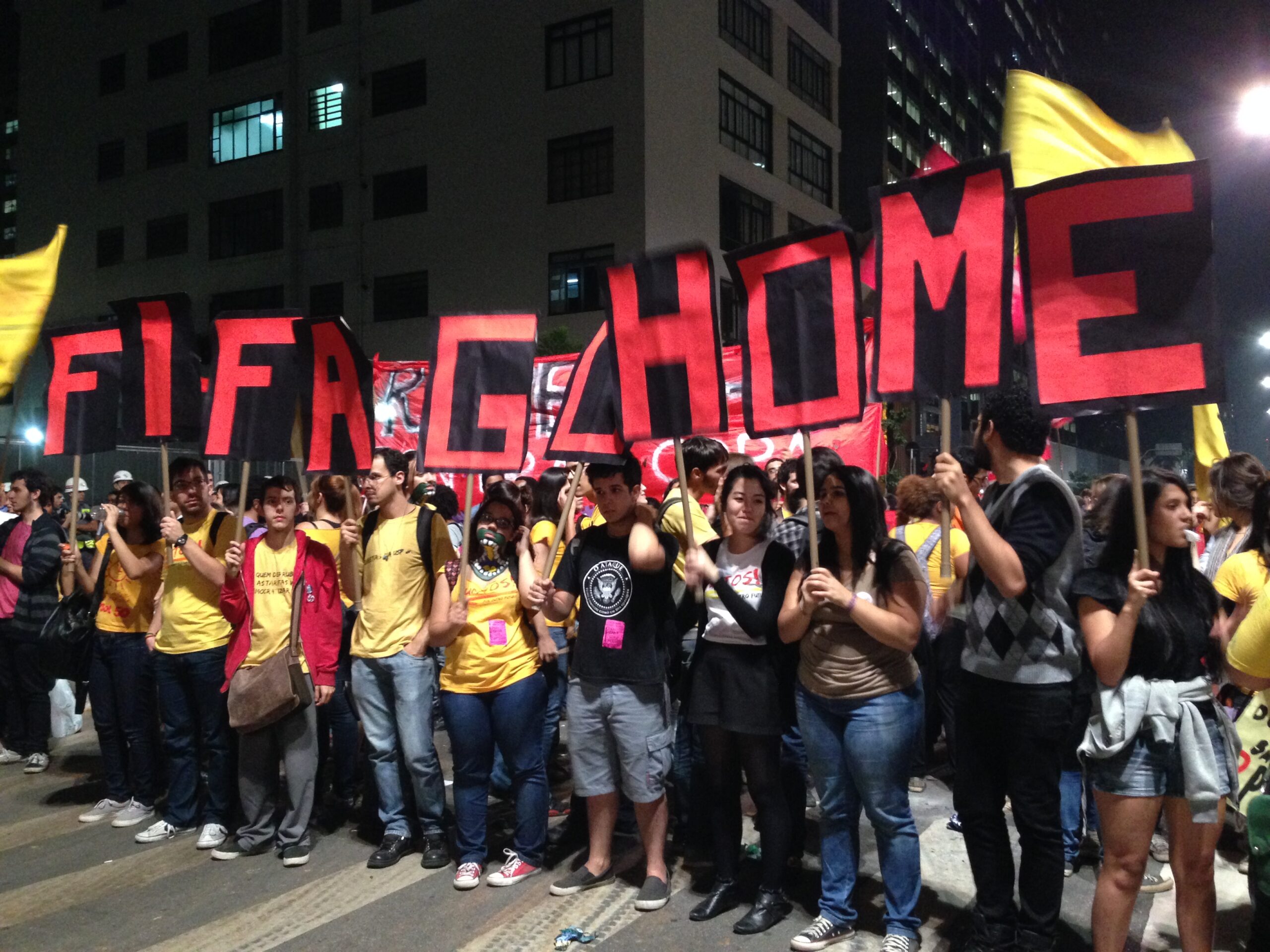
We look forward to organizing and growing with you, carrying forward the strategies and struggles of those who came before, thinking especially with the streets of Brazil where in 2014 voices in a football-obsessed nation came together to chant: Fora, FIFA!
-2026 World Cup Watch Collective