
“One of my lowest sales days was on Super Bowl Sunday,” Karolyn Plummer told the gathered reporters. Plummer owns Sweet Red Peach, a bakery across the street from SoFi Stadium in Inglewood, California. “I literally made under $600 for the day, I had to send employees home, and you’re just looking around like, ‘What in the world?’” Sweet Red Peach’s cakes are out-of-this-world scrumptious, as Plummer’s regular customers know — and as I can personally attest. But since SoFi Stadium opened in 2020, traffic for games and concerts has been so bad that locals avoid the area on event days.
That’s why, in November 2024, Plummer joined a group of local business owners in a press conference, denouncing the stadium’s negative impacts and demanding interventions from billionaire stadium owner Stan Kroenke and Inglewood’s mayor James T. Butts Jr..
Stadium boosters and mega-event organizers often claim that stadiums and the mega-events they host will benefit nearby businesses by generating additional foot traffic . But in one host city after another, many local businesses struggle as a new stadium or mega-event disrupts the rhythms their livelihoods depend on. Following the Paris 2024 Olympics, the AP reported that “many in the Paris service industry say they had one of their worst summers ever.” Security perimeters and closed metro stations limited access to shopping and dining streets near the Games venues. Olympic attendees typically spend lots of money at sports venues and hotels but they often do not match the spread of typical tourist expenditures across the region. For the London 2012 Olympics, the owners of businesses near venues who had expected a windfall were dismayed to find attendees were marshalled along routes that avoided their shops. Regular shoppers were in short supply, as city officials proactively advised Londoners to stay home during the Games.
As the 2026 FIFA Men’s World Cup brings eight games to “Los Angeles” this summer, we need to be skeptical of claims that World Cup crowds create a boon for “the community.”
LA’s World Cup Games will actually take place in the city of Inglewood. Inglewood is home to just over 102,000 residents, approximately 89 percent of whom are Latino and/or Black (compared to 94 percent in 2010). Two thirds of the city’s residents are tenants, susceptible to the rapid rise in rental rates that followed the city’s investments in new and upgraded sports and entertainment infrastructure over the last decade. In 2014, the newly renovated Forum arena reopened as a concert venue after years of under-use following the LA Lakers and Kings’ departures in 1999. SoFi Stadium opened in 2020 as a new home for the NFL’s Rams and Chargers, followed shortly by the Intuit Dome, which plays host to the NBA’s Clippers. SoFi Stadium will take center stage in the 2026 FIFA World Cup, rebranded temporarily as “the Los Angeles Stadium.” All three sports venues will host 2028 Olympics events.
“Initially, we thought the growth with these sports teams coming to Inglewood would help businesses tremendously,” civil rights activist Najee Ali explained at the 2024 business owners’ press conference. “In fact, it’s been just the opposite. Right now, these businesses along this corridor are being starved out.”
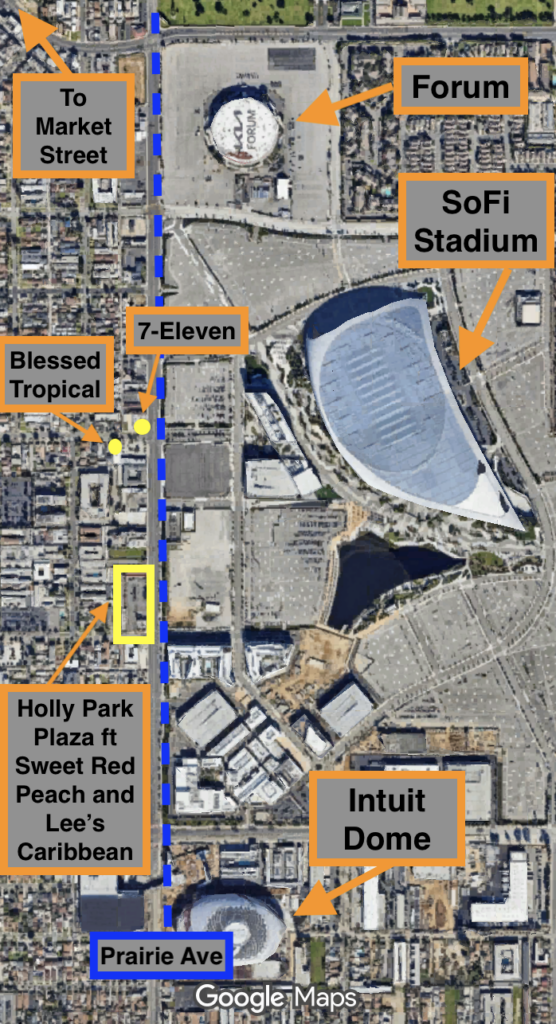
On event days, the City of Inglewood posts alerts on social media urging residents to avoid key stadium routes like Prairie Avenue. I have strolled along Prairie Ave on several NFL game days to observe where fans stop and where they pass by. At one intersection, where Prairie Ave crosses a driveway into the stadium complex, the 7-Eleven store has a steady flow of customers before games. Across the street, some fans also stop at the Snoop Dogg store or Blessed Tropical Cuisine, a Jamaican food joint. A staff member at Blessed told me gameday business is generally good, which is essential because the landlord increased Blessed’s rent significantly since the stadium opened. However, other businesses in the same lot — a nail salon, a dry cleaners — only experience the downsides of stadium proximity, as the landlord rents out their parking lot and their customers stay away. Further down Prairie Ave, fans mostly walk right by the Holly Park shopping plaza where Sweet Red Peach resides and where business owners held the press conference in 2024. Perhaps because the stores are slightly set back from the street, or perhaps because there’s no well-known franchise like a 7-Eleven to draw people in, a Jamaican restaurant in Holly Park Plaza called Lee’s Caribbean gets noticeably less gameday foot traffic than Blessed, even though its tasty patties make for an ideal pre-game snack.
The fact that some businesses do see bustling gameday business means stadium and mega-event boosters always have some examples to whom they can direct journalists. The owners of these businesses are typically willing to talk about their success and to use the media coverage to reach more potential customers. Similarly, professional sports teams and mega-event host committees cultivate partnerships with select local businesses who are then happy to praise their benefactor-clients. Success is both conveniently visible (e.g. long lines of people) and is made hyper-visible through selective spotlighting. In contrast, the businesses that are struggling and frustrated are less likely to be highlighted by sports boosters’ PR teams. And the businesses that have struggled the most and have had to close down are the most difficult to report on and document. Their stories are often displaced, along with their physical presence.
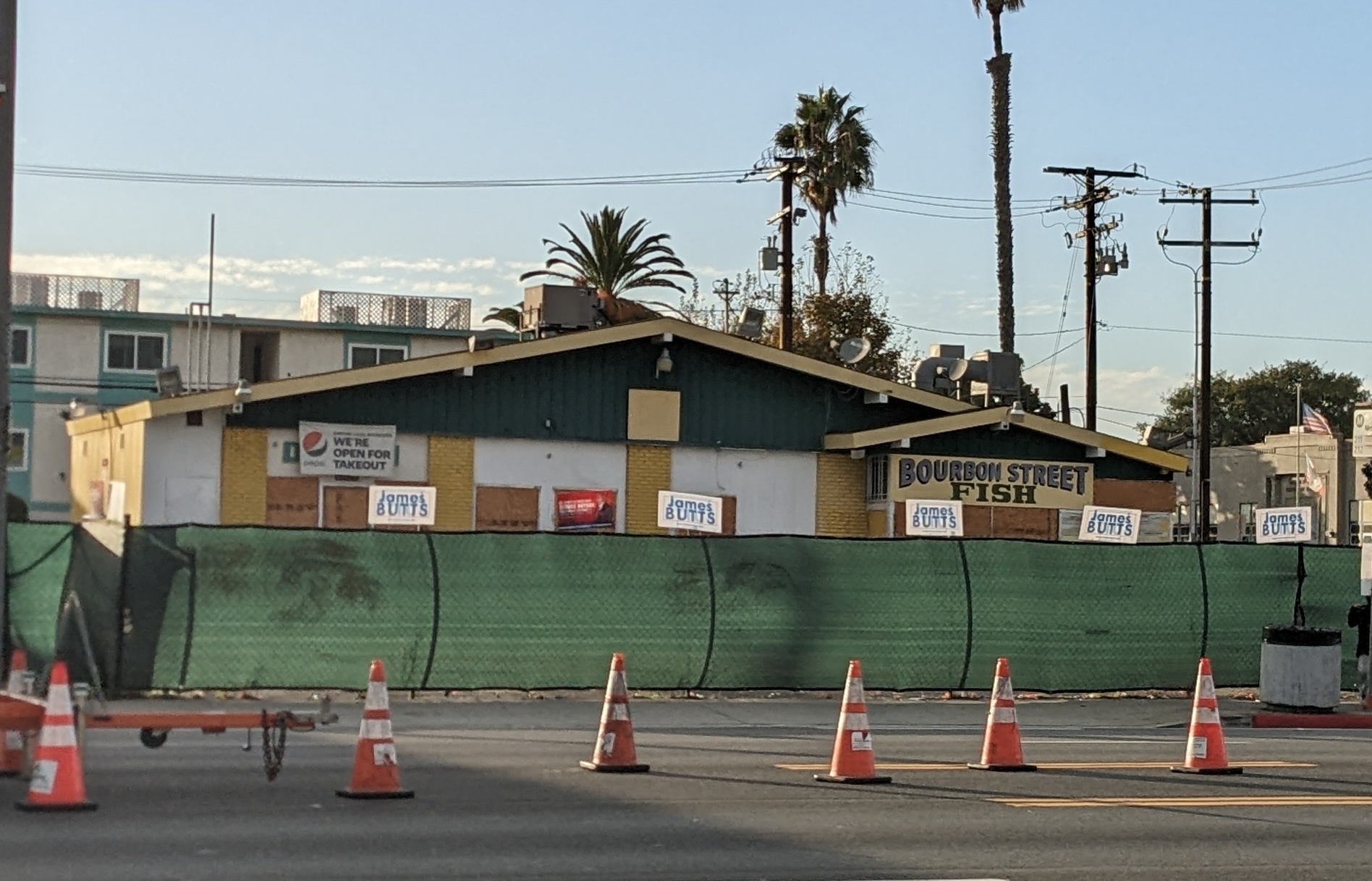
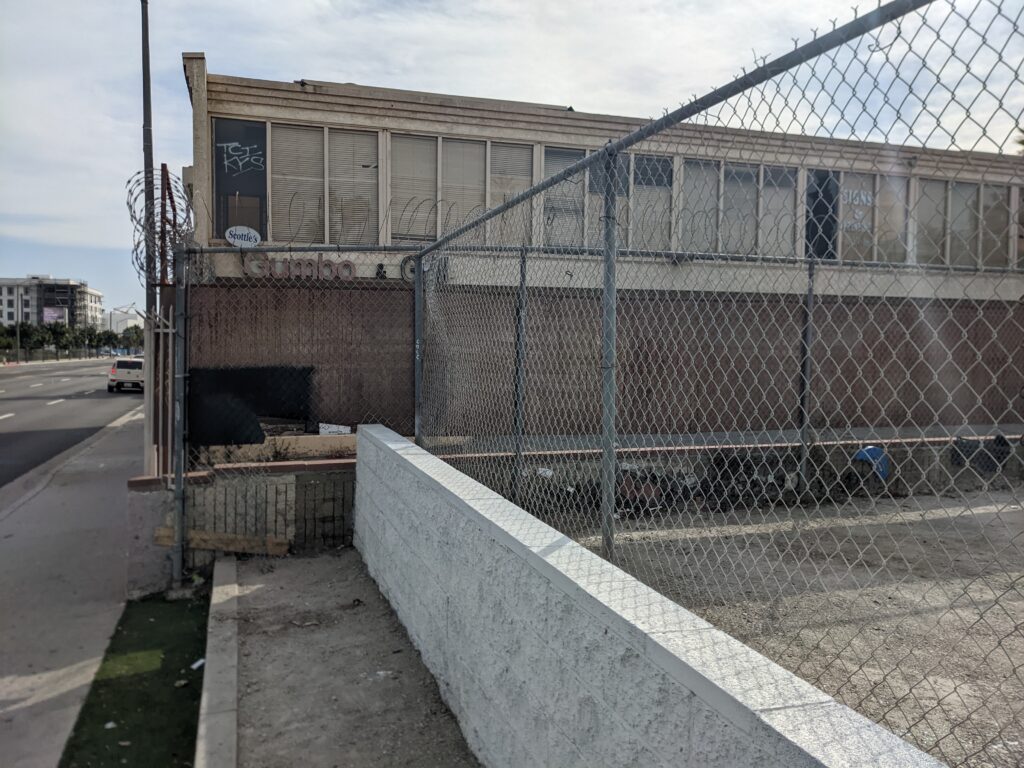
In Inglewood, there is a growing list of closed businesses, especially on Prairie Ave. Lawrence Scott was initially excited about the plan to bring a NFL stadium to Inglewood, but he struggled to keep Scottle’s Gumbo and Grill afloat amid the disruption of stadium-related construction and roadwork. Then, a new property owner forced him out shortly after the stadium opened in 2020. The building has remained empty and shuttered since. A popular two-decades-old restaurant, Bourbon Street Fish, closed in 2021 after the landlord refused to renew the lease, likely seeking to sell or to attract a more profitable land use. The restaurant was demolished and the lot has remained vacant since. Further south on Prairie Ave, the City of Inglewood used eminent domain to seize land for the Clippers’ venue, displacing a family-owned motel, Church’s Chicken, a warehouse, and an auto shop. Before the 2022 Super Bowl, a widely cited economic impact report listed 400 businesses within a three-mile radius of SoFi stadium that it claimed would experience a Super Bowl sales bump. Farcically, several of the restaurants closest to SoFi Stadium had permanently closed by the time the publication was released.
The Holly Park Plaza that contains Sweet Red Peach and Lee’s Caribbean now features more empty stores than active ones. For years, the City planned to acquire the plaza to make way for a light rail train to the stadiums. Although the individual business owners faced displacement if the train line went ahead, some, like Plummer, were eager to be compensated to relocate, given the traffic challenges of that location. But in 2024, the City suspended the train project as its budget ballooned and criticism swelled. Both the plaza owner and individual business owners had spent years acting on the assumption that they would be bought out or relocated: the plaza owner left stores empty rather than bringing in new retail tenants, while business owners hesitated to invest in their future in that location. The city government still aspires to build the train line one day, leaving the owners in a sustained state of uncertainty.
For now, in place of the suspended train line project, the City of Inglewood plans to construct a dedicated bus lane connecting Downtown Inglewood’s Market Street and its metro station to the stadiums. While the light rail would have displaced 41 businesses, the proposed bus project still entails using eminent domain to displace 23 businesses, mostly to make way for a “mobility hub” in what is currently the Inglewood Plaza on Market Street. According to renderings, this mobility hub appears to be a parking lot with a few pickup and dropoff stands for buses.
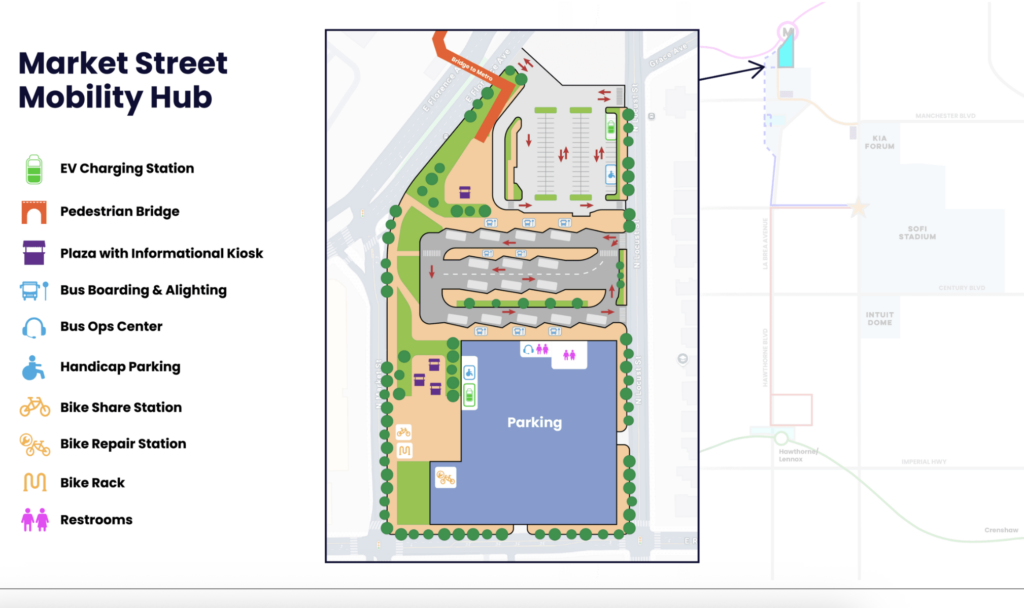
“Our family legacy will come to an end,” Amelia Selwyn, the owner of a jewelry store in Inglewood Plaza, said at a February city council meeting. For Selwyn, the city’s use of eminent domain is an extra tough pill to swallow because her family business previously had to relocate in 2017 to accommodate the city’s earlier redevelopment plans. The previous move was expensive. In an interview in April, she told me she has no reason to believe the city’s relocation compensation will be sufficient this time around, particularly as she will likely have to pay higher rent if she wants to relocate in the nearby area. “Being cut down again, I’m raising this little tree from nothing, and you’re cutting the top off. You’re topping us. Why?” She sees SoFi Stadium and the city’s other new mega developments as “billionaire games” in which Inglewood residents are “just like little ants to be squished.” “They look at us like nobodies,” she added.
At the February council meeting, a lawyer representing both Selwyn and the owners of the neighboring salon argued “there’s no evidence that the City evaluated a smaller or reconfigured hub footprint that would leave part of the site for existing businesses to remain.” A spokesperson for dd’s Discounts, one of the larger businesses in the plaza, suggested the businesses there could close during Inglewood’s busy mega-event events “in the spirit of collaboration,” so that the parking lot could be used as a mobility hub without the need for displacement. Nonetheless, the city council voted unanimously to approve the use of eminent domain.
The Inglewood Plaza business owners are not the only ones who stand to lose out. Many of their patrons are seniors who live nearby. I met Angelia in front of the plaza’s CVS store in March. She told me she often makes the short walk from her home in the adjacent senior residences to shop at dd’s Discounts, the GMD convenience store, and, most importantly, the CVS pharmacy. Angelia asked, “The senior citizens right next door — most of our medications come here. They start talking about knocking the whole thing down, so what are we supposed to do?”
For other patrons, the loss of 23 businesses will not be as critical but still raises concerns about Inglewood’s priorities. Johnnie Mae drives from her nearby home to the plaza for the CVS, the beauty supply store, and the auto parts store, and often likes to eat at the Fiesta Martins restaurant. “They’re making way for all these billion-dollar projects,” she said outside CVS in March. “What about the people that shop and live in the area?”
Inglewood’s Mayor James Butts has long promised that the new and renewed sports venues would drive a renaissance for Market Street, a once-thriving shopping street. But many Market Street storefronts are boarded up. The years-long uncertainty around the train project may have deterred some potential tenants from moving in. Even relatively new stores that the city government heralded as a sign of Inglewood’s resurgence — like the Black-women owned cafe, Sip and Sonder (opened 2018), and the Black feminist bookstore, The Salt Eaters Bookshop (opened 2020) — closed between 2024 and 2025 after struggling with high rents. A select group of remaining businesses on and around Market Street will receive city grants to invest in upgrading their spaces ahead of the 2028 Olympics. Butts claims the planned stadium bus will increase foot traffic, but the renderings suggest it will zip fans right past Market Street establishments.
According to Inglewood’s mayor and city council, these challenges are the necessary price of progress. “It’s not easy,” Councilmember Dionne Faulk said at the February council meeting on the mobility hub plan. “Progress is hard. Our city is developing at leaps and bounds. We want to do our best to keep up with the development for the benefit of our residents.” In 2022 Butts told the LA Times: “I can understand how so much development so fast could leave some people feeling left behind. But I say to them that we have a personal responsibility to ourselves and our children to prepare ourselves as best we can.” In 2019 he told Curbed LA that “businesses that have a desirable product” would “not only survive, they [would] thrive.” Across his interviews, the mayor frames business closures as a problem of insufficient “personal responsibility” or inadequate product quality, obscuring how his administration’s own choices have driven disruption.
Mayor Butts once compared SoFi Stadium with the Genesis Device from Star Trek’s The Wrath of Khan. In the movie, the Genesis Device can bring life to a barren planet. In 2019 Butts told the Daily Breeze that, when he was first elected, Inglewood “was a city devoid of hope with no aspiration for the future,” but the stadium was catalyzing its revitalization through the “Genesis effect.” Comparing a city home to 100,000 residents and their dreams to a lifeless planet recalls colonial logics in which imperialist nations declare they have a moral imperative to ‘develop’ and ‘improve’ lands imagined to be empty or underutilized. Importantly, the Star Trek franchise did recognize the potential horrors of the Genesis Device, which, as Daily Breeze reporter Jason Henry put it, “would first destroy whatever existed on an already habitable world to create a more ‘ideal’ paradise.” But Butts seems to have missed the moral of the story.
Leave a Reply