
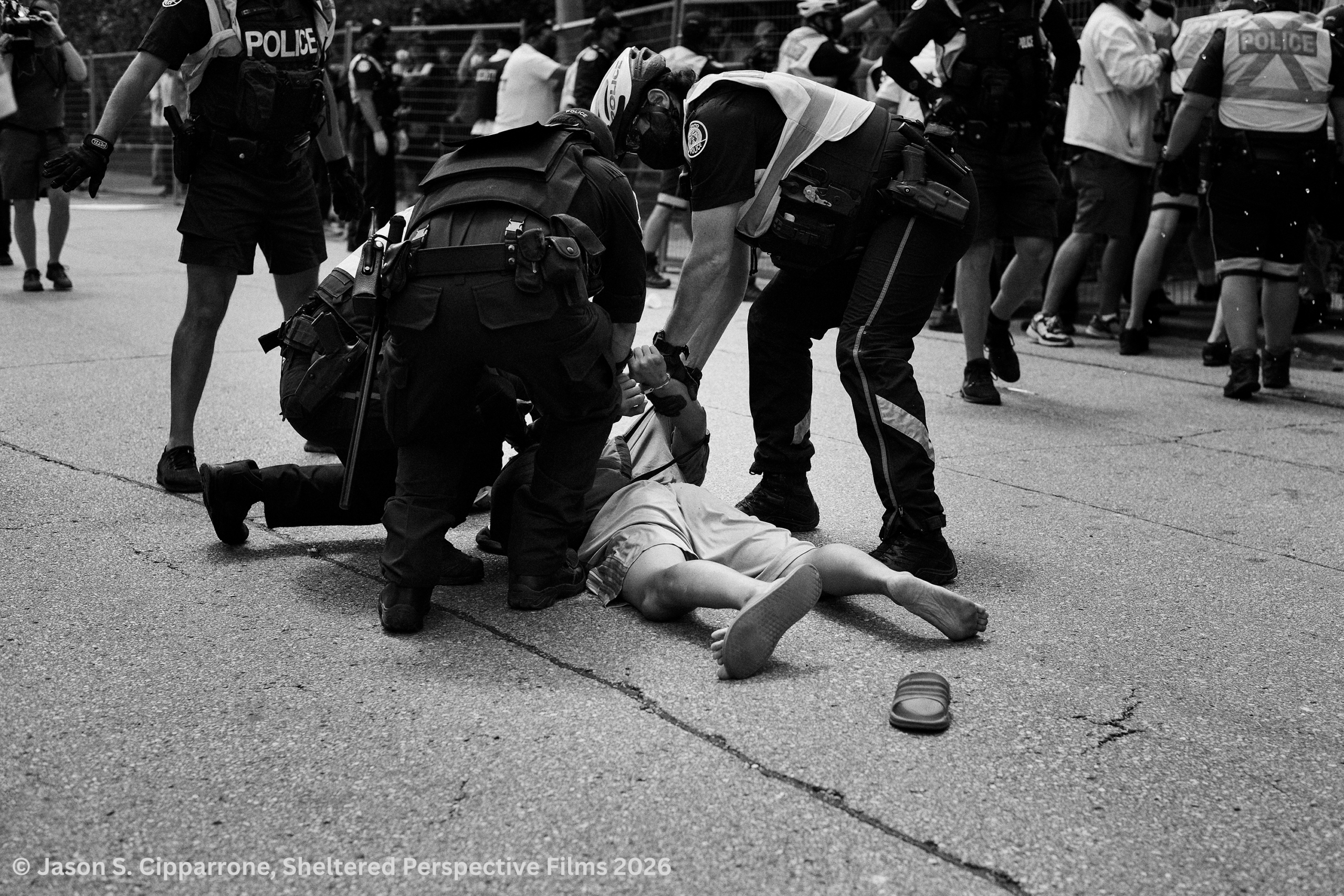
(Photo above: © Jason S. Cipparrone, Sheltered Perspective Films 2026)
By Claudia Vergara, Rhiannon Cobb, Isra Iqbal, Adam Ehsan Ali
As Toronto prepares to host the 2026 FIFA World Cup, the Parkdale neighbourhood, which is directly adjacent to the host stadium BMO Field is likely to disproportionately experience its impacts and outcomes, including increased displacement, surveillance, and policing.
Six FIFA World Cup (FWC) matches will be held at BMO Field south of Parkdale and Liberty Village from June 12th to July 2nd. Toronto is not only welcoming world-class footballers to its city beginning this Friday but also enhanced policing and surveillance across the city. Toronto Police Services (TPS) expects that the influx of worldwide attention on Toronto will encourage protests and demonstrations. As a result, the TPS is ramping up their presence and setting the city up to be effectively controlled and securitized as crowds roll in and the world sets its eyes on Toronto.
The TPS recently rolled out two public safety initiatives which includes equipping a new squadron of officers with riot gear and long rifles, to make weapons more visible in the hands of Toronto’s police officers. More recently, organizers have reported a significant uptick in harassment of unhoused and underhoused folks at Union Station, a major transportation artery connecting Toronto’s suburban commuters to the city’s subway network and rail system, with direct lines to its major airports. Further, the federal government announced up to $145 million in funding to support public safety and security for the World Cup. Part of this funding is going towards a new $12.5 million dollar security ‘command centre’ for the duration of the games.
Additionally, to facilitate the execution and organization of the tournament, the Ontario provincial government has invested $97 million to support Toronto’s role as a host city. At the municipal level of governance, as of April 2026, the City of Toronto intends to spend a total of $380 million, funded by City Reserves, federal and provincial grants, and third-party revenues, to cover city-level hosting costs. Taken together, Canadian governments are expected to spend just over $1 billion dollars in public funding to host the tournament across Toronto and Vancouver.
Thus, the opportunity costs of the FWC in Toronto – that the federal, provincial, and municipal funds being put towards hosting the event could have otherwise been used to address the needs of Toronto’s most vulnerable, including low-income, racialized, and unhoused people – are compounded by the deliberate targeting of these communities to make way for the global spectacle. By virtue of its proximity to BMO Field, the similar composition of its residents, and its history as a carceral space, Parkdale represents an important case study in assessing the violent impacts of the FIFA World Cup. While Parkdale has been shaped by displacement, policing, and institutional control, there is also a strong history of mutual aid, working-class and tenant organizing.
Parkdale’s Carceral and Organizing History
In the late 1800s, Parkdale was marketed as a quiet middle-class suburb outside the city. But as Toronto industrialized, working-class families, immigrants, and low-income residents increasingly settled in the neighbourhood. Over time, large Victorian homes were subdivided into apartments, boarding houses, and rooming houses. These forms of low-cost housing became critical to the survival of generations of newcomers, psychiatric survivors, poor and working-class residents, and people pushed out of other parts of the city.
At the same time, just east of Parkdale stood Central Prison and the Andrew Mercer Reformatory for Women; a prison notorious for abuse, forced labour, and the incarceration of poor, racialized, Indigenous, and “undesirable” women. Nearby, the Provincial Lunatic Asylum (which over years and many name changes and mergers, became The Centre for Addiction and Mental Health, or CAMH) confined psychiatric patients within institutional walls literally built through unpaid inmate labour. Some of these walls are still standing, preserved as a historic site.
The deinstitutionalization of these institutions, particularly the psychiatric facility, in the 1960s to 1980s had a significant impact on Parkdale. Thousands of former patients were discharged into the neighbourhood, often without adequate housing or community support. Many ended up in rooming houses, bachelorette units, shelters, or unhoused. Parkdale increasingly became stigmatized as a neighbourhood associated with poverty, drug use, and mental illness. Today, South Parkdale remains one of the city’s most renter-heavy and low-income neighbourhoods, while also facing intense gentrification pressures and rising rents driven by corporate landlords and speculative development.
The fight over access to space in Parkdale is ongoing, but the criminalization of the unhoused in this context was punctuated in 2021 by the violent eviction of a tent encampment at Lamport Stadium. The stadium is located on the grounds of the former Andrew Mercer Reformatory for Women, reflecting a longer history of policing and confinement in the area. The public outcry of this eviction led to a temporary shift in the city’s response to homelessness based around what they referred to as a human rights approach (though this was criticized by advocates for the unhoused). The Ontario government’s implementation of Bill 6, which expanded trespassing law fines up to $10,000 or imprisonment for up to six months for using drugs or failing to comply with a trespassing notice, however, represents another oppressive measure against unhoused people.
Addressing this broader carceral geography reveals a more expansive history of surveillance and criminalization in Parkdale. These legacies inform modern trends of policing, surveillance, and the ongoing criminalization of poverty, mental health, and drug use in Parkdale and surrounding neighbourhoods. Such dynamics have also been shown to intensify before and during international sport mega-events, which raises concerns for all those who call Parkdale home in the shadow of the FIFA World Cup 2026.
The Expansion of Surveillance and Displacement ahead of the World Cup
In this context, the FIFA World Cup brings with it expanded carceral reach. Doug Ford, Ontario’s Premier, has promised the expansion of power of Toronto Transit Commission (TTC) special constables to arrest people for using drugs on public transit. Amidst Ford’s closure of safe consumption sites and overcrowded shelters, the TTC has become a final site of respite for unhoused people. These examples of over policing and enhanced surveillance have become an inherent element within the planning, execution, and legacies of sport mega-events, ranging from the FIFA World Cup to the Olympic Games.
The Parkdale community has additionally witnessed early warning signs of displacement, including the early closure of the Better Living Centre (BLC), citing the venue’s pre-existing contracts with FIFA. BLC is a shelter and winter respite with about 250 beds. BLC’s residents were displaced into harsh winter weather a month before the site’s regularly scheduled seasonal closure. The City of Toronto said they would find shelter beds for those displaced in other shelters, but it is unclear whether this happened. Considering that the city is in a years-long housing crisis, where homelessness is becoming increasingly criminalized, and whose unhoused population is growing, we must be sceptical about the prioritization of the FWC over addressing the immediate needs and safety of the city’s most vulnerable. Such prioritization raises questions about whose rights count and where governmental priorities lie.
Parkdale also has a long and powerful history of resistance. Tenant organizing, mutual aid networks, community legal advocacy, harm reduction organizing, and grassroots mental health supports have all emerged in response to these ongoing forms of structural violence. For example, Toronto Underhoused and Homeless Union hosted a rally on May 26th, calling attention to the increased surveillance and harassment street-involved people have been facing from security and police forces in the months before the games. The rally was also to advertise the release of their report on increased violence by security against unhoused people at Union Station.
Thus, as the FIFA 2026 World Cup approaches, Parkdale offers an important reminder that mega-events do not simply create injustices; rather, they intensify familiar systems of oppression that Parkdale’s residents and advocates have been organizing against for many years.