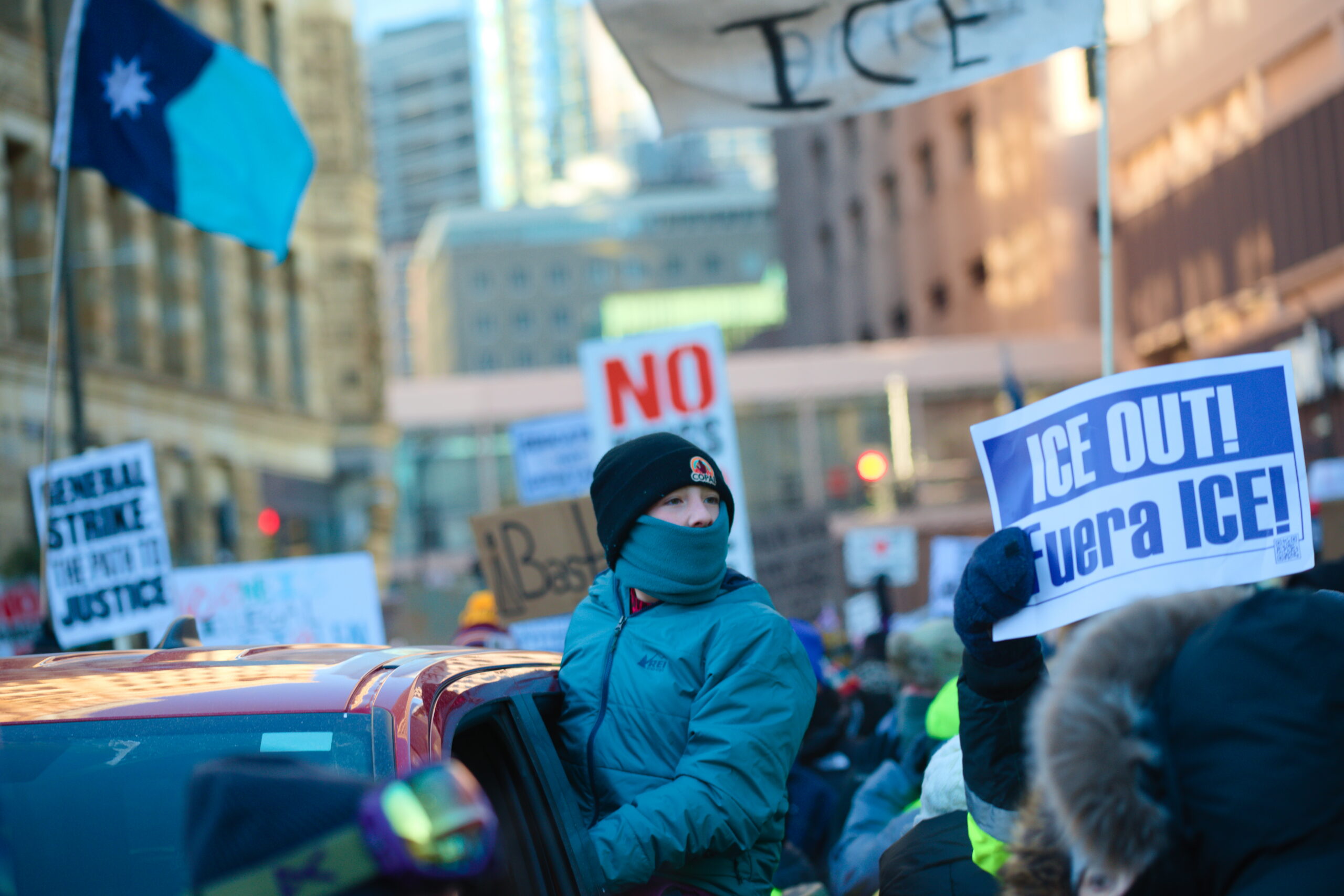
“ICE OUT protest in Downtown Minneapolis (2026-01-23),” by Fibonacci Blue is licensed under CC 4.0

On June 6, 2026, Iraq forward Aymen Hussein was detained for almost seven hours by U.S. Customs and Border Protection. After hours of questioning, undergoing “additional inspection”, and having his phone seized and searched, Hussein was ultimately permitted to enter the United States. However, after being subjected to the same treatment for over 10 hours, Talal Salah—the Iraqi team’s official photographer for the 2026 World Cup—was denied entry into the U.S. Subsequently, the veteran Iraqi sports photographer will be unable to document this landmark moment in the nation’s sports history: Iraq’s first World Cup appearance since the nation first qualified 40 years ago. A qualification, perhaps uncoincidentally, secured by Aymen Hussein‘s game-winning goal against Bolivia in the intercontinental play-offs. According to photography journalist Jeremy Gray, Salah’s absence was “immediately noticed” by Iraqi futbol fans worldwide. Despite the lack of travel ban for Iraqi nationals or people arriving to America from Iraq, this prejudicial treatment is not surprising; it was predicted by over 120 civil society groups in their travel advisory to racialised players, fans, and journalists of the game who plan to visit U.S. for the 2026 World Cup. Unfortunately, xenophobic human rights infractions by ICE and CBP are just are just another element jeopardizing the accessibility and safety of this tournament.
American legislation surrounding immigrant rights has long been a case study for structural racism. Throughout history, racialised immigrants—whether documented or undocumented—have faced greater scrutiny and harsher punishments than their white counterparts. This history includes, but is not limited to:
- The Chinese Exclusion Act of 1882, which prohibited most Chinese nationals from immigrating to the United States
- The requirement of being white for immigrants to be nationalised, in place from 1792 to 1952
- The national quota system that disproportionately facilitated immigration from Northern Europe while greatly restricting migrants of colour into the United States, used from 1924 to 1965
- The 1954 initiative officially known as “Operation Wetback,” in which the federal government removed hundreds of thousands of people with Mexican ancestry from the United States
Yet, when millions of predominately white Europeans entered America without authorization in the 20th century, they faced “virtually no threat of apprehension or deportation,” (Kamaski, 2021). Prior to the 1950s, tens of thousands of white undocumented immigrants were given amnesty, and they faced little to no restrictions on public benefits until it was outlawed for all immigrants in the 1970s. Additionally, although hiring undocumented white immigrants was incredibly prominent in the early 20th century, it became illegal in 1986 after stark changes in immigration demographics.
Evidently, racialised immigrants have never been deemed worthy of comparable supportive legislation in America. As the demographics of undocumented immigrants in America shifted to primarily Latino and people of colour, so too have the discourses and laws surrounding these groups. After centuries of racialised immigration policies, the aforementioned privileges (or more accurately, human rights) afforded to white noncitizens are continuously withheld from the primarily racialised undocumented immigrant population today. In fact, research shows that xenophobic beliefs, especially anti-Mexican sentiments, greatly “shaped [American] law and bureaucratic practice,” surrounding temporary migration, work visas, family separation, unauthorized entry, and access to public benefits (Kamaski, 2021).
Over the past 17 months, the maltreatment of undocumented and documented immigrants, people of colour, and their allies has only escalated. Since he first ran for office, Donald Trump has called Mexican immigrants “criminals” and “rapists”, and argued in favour of banning noncitizens from “shithole” countries such as Haiti and El Salvador from staying in the United States. Since then, Trump has issued three versions of the Muslim ban and established official policy for separating Central American children from their parents. From flagrant lying about the number of undocumented immigrants in the United States to fear-mongering about unproven criminal activity by noncitizens, Donald Trump weaponises openly racist discourses to appeal to his right-wing audience and justify anti-immigrant legislation.
This, in turn, has shifted the current range of policies, ideas, opinions, and behaviours that the public finds politically acceptable to include and normalize extremist xenophobic sentiments, which is perhaps most evidently demonstrated by the domestic terrorism ICE has unleashed on cities across America with high immigrant populations. Documented and undocumented immigrants alike live in fear of being separated from their families, seized, sent to dangerous environments they’ve fled from, deported to random countries, or even killed. Since Donald Trump’s second inauguration, there have been 51 reported deaths in ICE detention (as of June 8, 2026). This does not include Jaime Alanis Garcia or Jose Castro-Rivera, who died trying to flee ICE agents in 2025. This does not include Keith Porter Jr., a 43-year-old Black American and father of two who was fatally shot by an off-duty ICE agent on New Year’s Eve. This does not include Renee Good or Alex Pretti, white Americans who were fatally shot by on-duty ICE agents for protecting their neighbours. For an abbreviated list of some of the names and lives this statistic does include, see below.
By choosing the United States as a co-host of the 2026 World Cup—and awarding Donald Trump the inaugural “FIFA Peace Prize“—FIFA is cosigning America’s violent and xenophobic immigration policy. Despite their proclaimed dedication to “Human Rights & Anti-Discrimination,” FIFA has apparently turned a blind eye to the violent and racialised migration operations, abusive immigration policies (including enforced disappearances under the Alien Enemies Act), and increased detention. FIFA estimates that up to 6.5 million people could attend the 2026 World Cup across the host countries, with 11 out of 16 host cities located in the United States. However, when a third of the countries participating in the World Cup face some sort of travel or visa ban, it is hard to imagine how America plans to host an international tournament with the stated goal of “[uniting] the world“. Human rights groups warn fans and extended family members of players from travel-restricted countries competing in the World Cup about the potential of being delayed, denied, or even detained, as they are still prohibited from entering the United States.
- Travel Ban
- Visa Shut Down
- Travel Ban and Visa Shut Down
- Visa Shut Down and WC Competitor
- Travel Ban, Visa Shut Down, and WC Competitor
As briefly alluded to above, over 120 civil society groups have banded together to issue a travel advisory for those seeking to visit the United States in celebration of the World Cup. Their letter cites a deterioration of human rights that could put fans and journalists in jeopardy, namely due to militant ICE raids and a suppression free speech. After ICE declared that its agents would play a “key part” in the tournament’s security, the advisory specifically warns about the possibility of:
- Arbitrary denial of entry;
- Arrest, detention and/or deportation;
- Expanded restrictions and limitation on travel and entry to the U.S.;
- Invasive social media screening;
- Searches of electronic devices;
- Unconstitutional immigration enforcement;
- Racial profiling;
- Suppression of speech and protest;
- Increased surveillance;
- Degrading treatment in ICE detention or custody; and
- Death
Quotes from the signatories include:
“FIFA has been paying lip service to human rights while cozying up with the Trump administration, putting millions of people at risk of being harmed and their basic rights violated.”
Jamil Dakwar, ACLU human rights program director
“Fans, journalists and others traveling to the United States for the 2026 FIFA World Cup risk encountering a deeply troubling human rights landscape, shaped by the Trump administration’s racist immigration policies, mass detention and deportation, and attacks on freedom of expression and peaceful protest.”
Daniel Noroña, Americas Advocacy Director with Amnesty International USA
In sum, FIFA failed to “red card” America’s violent and prejudiced immigration policies. Choosing a country to host an international mega-event must come with accountability and methods to ensure that the human rights of all are protected. If FIFA wants football to “unite the world”, the entire world must have the safety to enjoy the game—and Donald Trump has shown no intrinsic motivation to protect the rights and dignity of those who are most marginalised. The International Federation of Association Football must do better than handing out meaningless ‘Peace Prizes’. With just days until the first game of the 2026 World Cup, there is little meaningful change that can be done ahead of this tournament. However, FIFA must do better in the future. If the federation can mandate heavily policed and “cleansed” Controlled Areas around stadiums, they must use their leverage to enforce equity and respect for all fans and journalists of the game.
Victims of The U.S. Federal Government’s War on Racialised Immigrants
One death in ICE detention is too many. This is a list of 17 people who have died under more-than-mysterious circumstances while detained by ICE over the past 16 months. They were people—family members, friends, neighbours, colleagues—whose lives were cut short by a fascist regime determined to scapegoat migrants for social ills.
- Royer Perez-Jimenez, a 19 year-old from Mexico who was found “unconscious and unresponsive” in detention
- Mohammad Nazeer Paktyawal, a 41 year-old from Afghanistan who fell ill after being arrested by ICE, despite having no known health issues prior to his death
- Emmanuel Clifford Damas, a 56 year-old from Haiti who died frim a tooth infection after not being allowed to see a dentist
- Alberto Gutierrez-Reyes, a 48 year-old from Mexico who died from diabetes and high cholesterol after being denied access to medical care
- Lorth Sim, a 59 year old from Cambodia who was found unresponsive in ICE detention
- Parady La, a 46 year-old from Cambodia who died from anoxic brain injury, post cardiac arrest, shock, and multiple organ failures after being denied medical care
- Lunas Campos, a 55 year-old from Cuba whose death was ruled a homicide by asphyxia; Campos was choked to death by a guard
- Nenko Stanev Gantchev, a 56 year-old from Bulgaria who was found unresponsive in his cell after months of complaining about his declining health
- Delvin Francisco Rodriguez, a 39 year-old from Nicaragua who was found in detention without a pulse or brain function for no explained reason
- Fouad Saeed Abdulkadir, a 46-year old from Eritrea who died of medical distress following complaints of chest pain and inadequate medical care
- Jean Wilson Brutus, a 41 year-old Haitian who died of suspected natural causes according to ICE
- Francisco Gaspar-Andres, a 48 year-old from Guatemala who died of suspected liver and kidney failure due to underlying causes disputed by his widow, Lucía Pedro Juan; Juan was deported to Guatemala without a chance to see Gaspar-Andres before his death
- Gabriel Garcia-Aviles, a 56 year-old from Mexico man who died of cardiac arrest; he had been living in the U.S. with a work permit for over 3 decades.
- Santos Reyes-Banegas, a 42 year-old from Honduras who died less than 18 hours after being detained by ICE from liver failure
- Lorenzo Antonio Batrez Vargas, a 32 year-old from Mexico who died from suspected “pulmonary complications”
- Chaofeng Ge, a 32 year-old from China who was found hung in detention with his hands and feet bound; an investigation is ongoing.
- Johnny Noviello, a 49 year-old Canadian who was found in detention unresponsive; it is unclear whether ICE provided Noviello with appropriate medications for his health issues