
By: Jair Coronado Rosales
Mexico City continues to grow, continues to transform itself, to modernize itself. It hosts mega-events such as the 2026 FIFA World Cup, and in the midst of this process, it is displacing people and selecting new inhabitants; it forgets its traditions and popular practices; it steadily and violently makes way for real estate capital and housing speculation.
The pace of these transformations is accelerated, especially as Mexico City acquires global status by using the World Cup as a showcase. Nevertheless, within this entire web of changes, regardless of the FIFA World Cup itself, Mexico City is a space where different forms of protest, different forms of resistance, and different struggles unfold.
One of the many reasons that has driven people to protest has been the intensification of the commodification of the capital city, as well as the State’s position toward highly sensitive public demands, especially regarding the issue of disappearances in Mexico. Commodification has occurred excessively and has been accompanied by an intensification or growing complexity of the privatization of public spaces, protected areas, basic public services, mobility, popular traditions, football itself, culture, and even identity.
Gentrification, touristification, Uberization, and displacement are all expressions of the commodification of the city, prioritizing mega-events such as the FIFA World Cup over long-standing and deeply sensitive demands, such as those of the “searching mothers” and the urban communities of Santa Úrsula Coapa, San Lorenzo Huipulco, and San Pedro Mártir regarding water hoarding and the destruction of memory and identity.
Faced with this scenario, dominated by violent global capitalist imposture, in which confessed criminals, cowardly pedophiles, and well-dressed psychopaths are allowed to govern, in the capital city of Mexico, dissenting voices are emerging, protests of resistance found in art, especially music and lyricism, a means of raising awareness and transforming reality. What the FIFA World Cup makes possible is the global exposure of the events taking place in a city like Mexico City, events that often go unnoticed by a distracted gaze, yet occur alongside the capitalist spectacle.
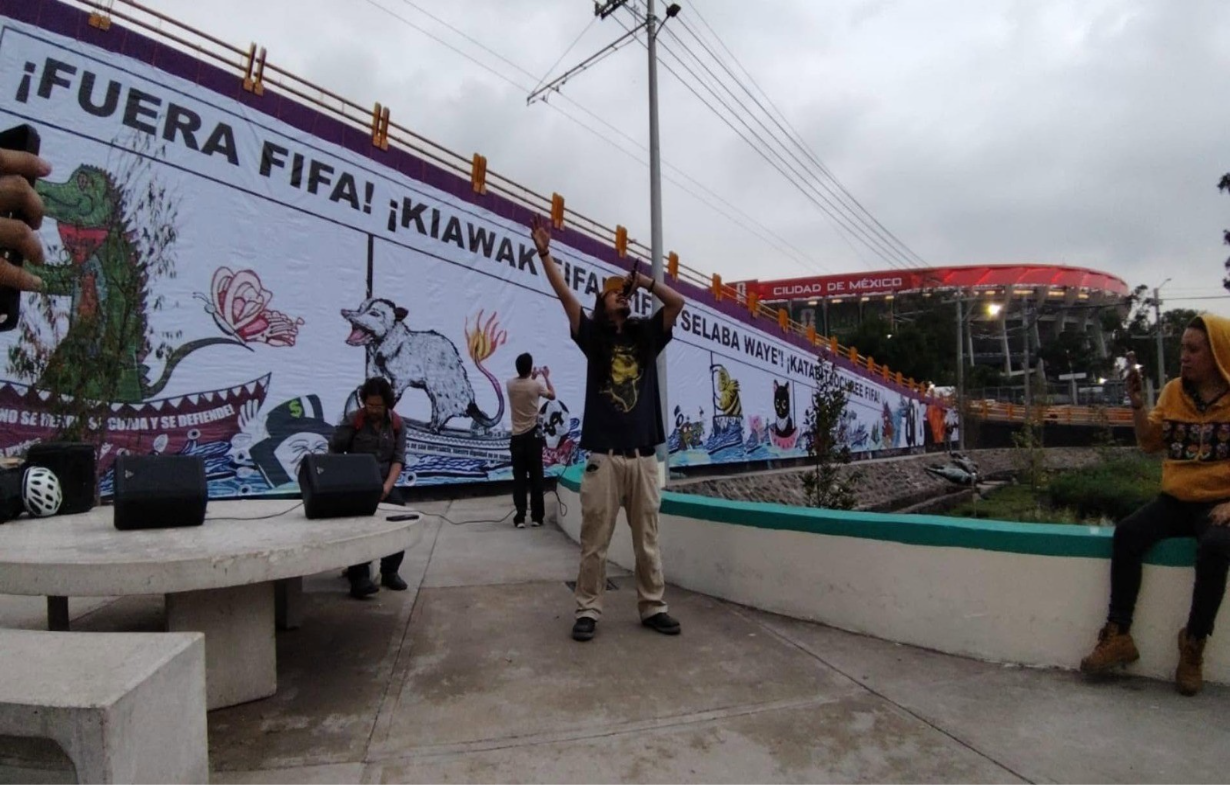
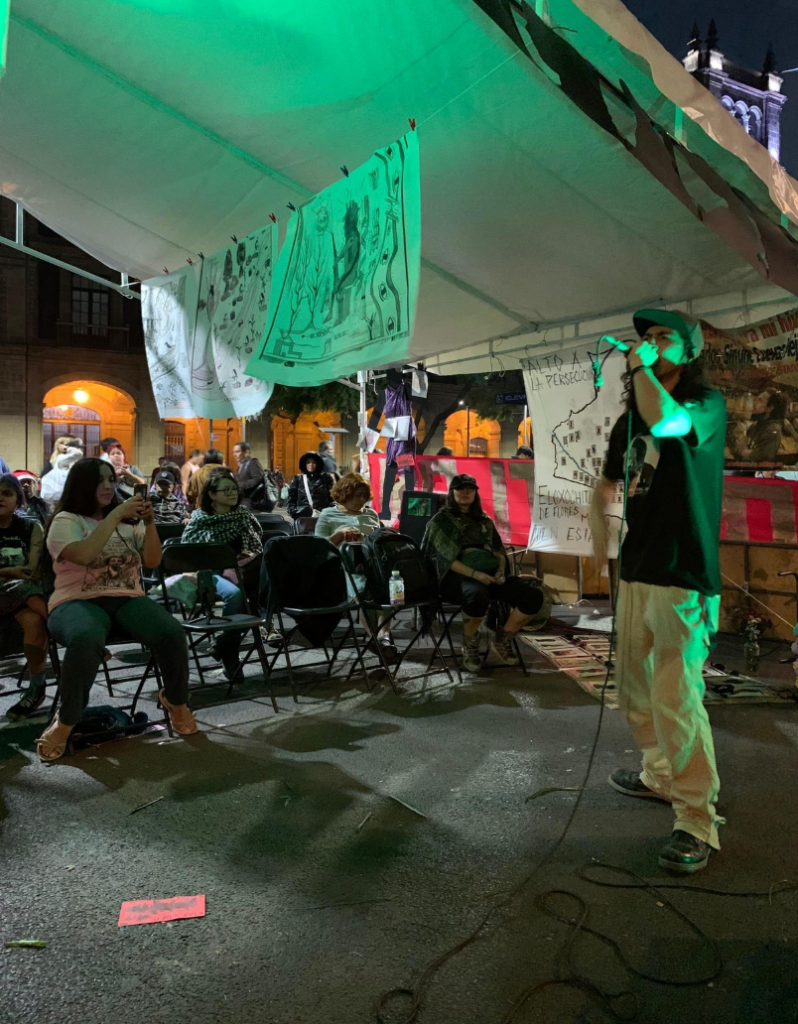
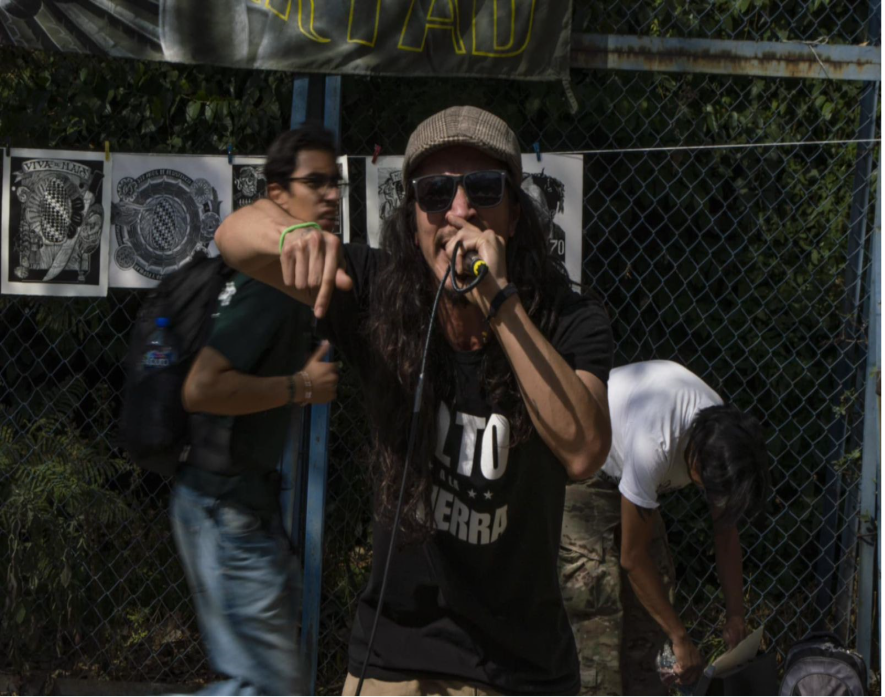
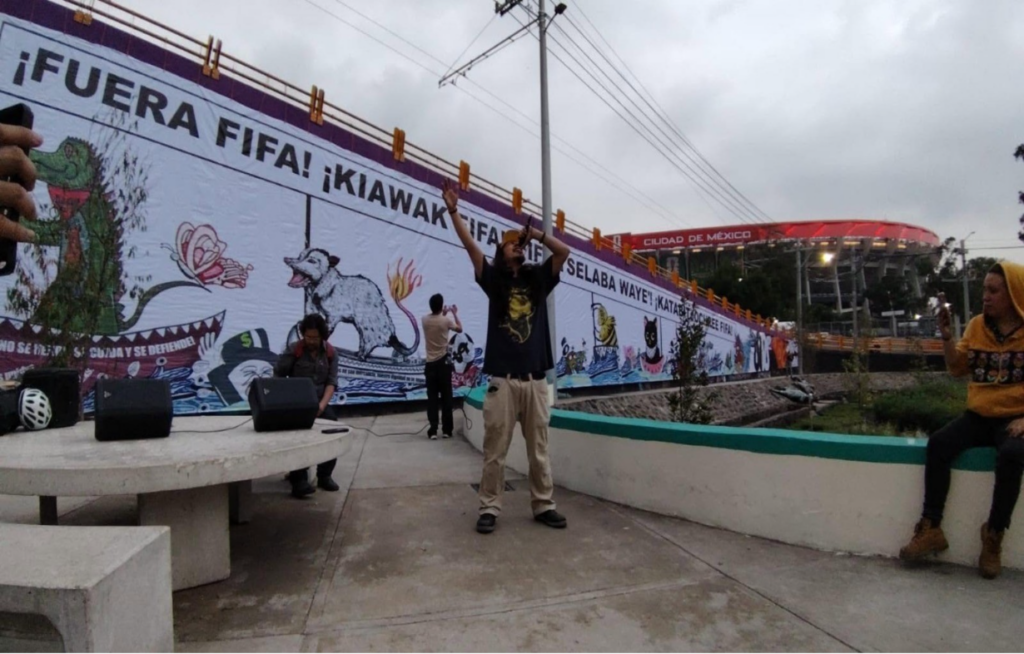
In this regard, it is important to recover the thoughts, feelings, and motivations of one of the people who, through his artivism, not only expresses his resistance and anti-capitalist struggle, but also reveals through each of his actions, rhymes, and interventions what many people feel but still do not dare to act upon in order to transform their reality. Amid the mega-event that Mexico City is currently being experienced and endured, I was able to to interview Hunaac-cel, an artivist who, through his music, lyrics, and body, has been supporting the various protests and struggles that have emerged against the FIFA World Cup and that have occupied different spaces throughout the city to demonstrate, reveal, expose, denounce, and make visible what this mega-event seeks to conceal, silence, overshadow, or erase, primarily, how this city is at the mercy of private, corporate, and banking interests that seek our distraction and submission through spectacle as the most effective means to continue dispossessing, displacing, destroying, selling, hoarding, and so on.
The following is an excerpt from the interview with Hunaac-cel on June 22 of this World Cup year, with the intention of sharing what it means to inhabit a city like Mexico City through the lens of artivism.
– Jair: Do you identify as a “chilango”?
– H-cel: I prefer “Defeño.”
– Jair: Do you identify with your neighborhood?
– H-cel: Yeah, but my neighborhood has been getting more and more posh, and there’s a lot of PAN supporters, right? And I’ve kind of lost a little faith in the neighborhood, but it definitely defines me, more as a “barrio,” not so much as a “colonia,” but as a “barrio”; Tacubaya is nearby, Daniel Garza is here, San Miguel Chapultepec, I mean, places like that, though it’s also close to La Condesa, but I don’t really identify with it.
– Jair: Do you remember any violent incidents you’ve experienced or heard about recently or in the last few months?
– H-cel: Well, one of the issues would be the attempt to privatize Parque Lira, that the government wanted to put some kind of Disney-style 3D thing there or something like that and started privatizing a place where I used to play as a kid, and where people from the neighborhood still play. So yeah, it was like, supposedly it was just going to be for that show, but the damn government little by little keeps privatizing spaces, right? So that did feel like violence, and we neighbors organized ourselves. We protested, and in the end we managed to save the space.
– Jair: Do you remember how you felt when you heard that news? Or did you experience a range of emotions?
– H-cel: Well, emotions, I said, how can these bastards never get enough money, and on top of that, they’re going to run in the elections, right? Powerless, nostalgia that the city just isn’t the same anymore and capital is devouring it.
– Jair: Which spaces in Mexico City do you consider to be violent?
– H-cel: I think the whole city is violent toward those who have the least, toward the most vulnerable. That is, people living on the streets; I find it violent when architectural structures have spikes installed to keep them from staying there. It also feels hostile. That strikes me as violent, I even find gentrification itself violent, don’t you think? For example, in this neighborhood, there have been times when I walk my dog and all I hear is English or other languages in the mornings; and I think… like when I go to the market and see that all the prices are going up, right? I mean, even rents. So that strikes me as violent, too.
– Jair: So, let’s say, following that logic of the violence you perceive, which spaces reproduce that violence? Here in the city, which neighborhoods have you seen where that kind of violence has increased?
– H-cel: I think it’s happening all over the city, because right now the concept being developed in the communities is that of the “commodity city”, where they want the city solely to produce, and they want to push us further and further out to the outskirts. And only those who have the money to rent here and eat here, well, they’ll be the ones who can live here, the ones who can afford it. And the city is going to get more and more expensive, and we, the city’s original residents, are going to have to retreat if this dynamic continues.
– Jair: So would you say the city is violent toward its own residents?
– H-cel: Yes.
– Jair: So, don’t you feel confident about your city?
– H-cel: About my city, yes, about the politicians, no, about the form of government, no.
– Jair: How do you feel about living in a city like the one you live in?
– H-cel: Well, look, I do have a strong sense of identity with the city. And yes, deep down I think I want to fight for it, right? I like it, I like it. In fact, right now, because of my career as an artist, the city is where there are the most opportunities, right? So, here I am, I like it, but there are certainly many difficulties to making it a better city, right? And I think that’s the responsibility of those in power.
– Jair: Let’s say, if you had to identify three feelings that you constantly, well, not exactly “deal with,” but rather experience from living in the city. What would they be?
– H-cel: Nostalgia, powerlessness and abandonment, I mean, when I think about the subway, not this one, but all the others, completely jam-packed, people crammed together, it’s a sense of abandonment, really brutal.
– Jair: Okay, well, let’s move right on to a topic you touched on, which is this aspect of subversion, organization, and social resistance. Why do you think it’s important to protest or take a stand based on discontent, in the public sphere? Why do you consider that to be necessary, even?
– H-cel: Well, look, in the system we live in, capital rules, right? And capital tends to reproduce its own profits. It’s not going to do anything that threatens capital itself. In that sense, it’s the idea of progress, from which you can do many things, right? Like the government installing cable-supported buses and other things, but there’s an intrinsic displacement within those processes, and the only thing that can stop capital, the only thing that can put the brakes on it, obviously not the politicians who are in bed with business leaders, is the free people. So it seems to me that if it isn’t the people who take to the streets to determine their future, then it’s no one.
– Jair: What do you think about the use of police force in response to protests?
– H-cel: Well, first they said there was no longer a riot police unit, right? And then it was quickly revived. And I’m against those repressive forces, I mean, exactly, I mean, for example, the police, and even the army, serve to maintain a system through coercion. So, precisely, it’s the police who repress the people so that these things don’t happen, so that the future isn’t better. So I don’t respect, I don’t believe in any authority, especially if they come to beat people up; because they also come to infiltrate; they also have informants and thugs, right? I mean, it’s not just the person dressed as a police officer, but the entire institution itself, which has thugs and its own enforcers.
– Jair: And what does it make you feel when you see people who are politically apathetic or uninterested?
– H-cel: Well, to be honest, it really gets me down. A really bad example was just the other day during the Mexico vs. Korea game, I think a lot of people from Toluca and Cuajimalpa and places like that came down here. And when the game ended and Mexico won, there was a total crazy chaos, right? Horns blaring everywhere, it was crazy, right? I’m against the World Cup, not against soccer. I think soccer is an awesome sport. [But] I had to take my dog out, and I felt really threatened. For example, I mean, I think ninety percent of the drivers who were honking like that were drunk. And there were a ton of them. Plus, you can’t say anything to them because they’re out in a pack and they’re drunk and they don’t think, they think as a mass or a herd. So they go to “El Ángel” to celebrate Mexico’s win, they piss on the roundabout dedicated to the disappeared, they harass the mothers searching for their missing loved ones, they throw a shitload of trash around, no, and I’m really like, man, Mexico didn’t even play that well to make such a huge deal out of it. And second, it’s like they’re pissing on the roundabout for the disappeared, they’re screwing over the mothers of the disappeared. I mean, they only take to the streets for that so-called nationalism, that patriotism which I call bullshit because they’re not out there to defend the natural resources of their territory, nor their disappeared; but just to be duped by television, that’s how they’re portrayed and it makes me really sad, and I feel powerless, and I think that, unfortunately, Mexico is the way it is because of that kind of phenomenon, right?
– Jair: Moving on to this topic of the World Cup, which is intertwined with this experience of various protests and especially those with different motives, do you think it was necessary to host a World Cup right now?
– H-cel: Look, when I think about FIFA, I start thinking about the Epstein files. And I mean, how many people on the Epstein list aren’t the very ones organizing FIFA? I mean, so a bunch of pedophiles, thieves, genocidal maniacs, they’re the ones organizing these World Cups. So, if that’s going to be the case, there shouldn’t be any World Cup at all. Not just this one, but none at all. If they’re going to put cities into debt, like what happened in Brazil and Mexico to make this happen without paying taxes, the World Cup shouldn’t be held, right? I mean, if we’re talking about a different kind of World Cup where soccer in every country isn’t corrupt and they actually play good soccer, for example. I mean, there’s a war going on and there are World Cups, what the hell is that all about!? So I think there could be a different kind of World Cup, one without all this “touristification,” without these “dudes” who organize it, but if that’s how the World Cup is going to be, the way we’ve always known it, I don’t think it should exist.
– Jair: And for example, you were talking about commodification and this “city as a commodity.” What do you think about ticket prices?
– H-cel: No, well, it’s just for tourists and the really rich people around here. I mean, I think it’s awful. Even I wanted to watch that damn game. And I had nowhere to watch it on my computer because I don’t have a TV. So, this is like, hey, how am I supposed to not be able to watch a damn World Cup soccer game? No, I mean, there’s so much corruption, it’s a business just for them, in many ways.
– Jair: Let’s move on to a subject that moves you, music, how have you managed to bring together these two aspects, protest but also artistry?
– H-cel: I feel that my project is based largely on supporting struggles, second, I don’t think my art is propaganda, it’s irreverent, it doesn’t tell you to be an anarchist, to be a communist, Lenin said this, it’s not like that, being critical of a situation, but we have to figure out how to solve it. I don’t have the solution as such, which is why I don’t make propagandistic art, but rather art that tries to raise awareness among young people, and in that sense, this whole conscience thing strikes me as a superiority complex. That’s what my artistic project is about, trying to raise awareness and create visibility.
– Jair: How would you say that art or music helps raise people’s awareness?
– H-cel: I have this theory, which isn’t mine, I think it’s Gramsci’s about cultural hegemony, because I believe that if a revolution, let’s say it wins, but hasn’t achieved cultural hegemony, the revolution will falter, because people aren’t at that cultural level of struggle to carry it out, they just follow leaders. It seems to me that the cultural struggle is essential for victory and a better world.
– Jair: Do you think music and art help you deal with this violent world?
– H-cel: Yes, I do think so, and I say this not as an artist but as someone who listens, I mean, I put on music when I’m feeling down because of everything that’s going on, I put on protest music, and it turns that hopelessness into rage, you know, it helps me stop feeling depressed, because with all this damn war, well, you get down, you get depressed, and so music has to lift that hope, it has to take away that depression, transform it into anger, into awareness.
To follow Hunaac-cel’s artivist work, you can find him on social media:
Facebook: Hunaac-cel Lunático Indómito
Instagram: Hunaaccel
Youtube: Hunaac-cel