
-by Carolyn Prouse
Croatia was a hair away from potentially sending Portugal packing in the round of 32 when a VAR-decision called the goal back: apparently the sensor in the Trionda had picked up a slight signal of a hair brushing the ball, rendering the play offside. There has been a lot of controversy, and rightly so, for how these digital and AI-driven technologies are disrupting the flow of the game and displacing human decision-making to technical decisions that sideline subjectivity and even good sense. In the first blog post of this series I discussed how these digital technologies are wrapped up in histories of military ‘innovation,’ and the kinds of depoliticizing effects this has for the game and our everyday lives. In this blog post I consider stadium surveillance more generally, especially in an era of digital capitalism where the smart stadium has become an incubator for, and extension of, the smart city.
In the stadium, on the pitch and in the stands, bodies and movements are parcelled, conjoined, and brought into new assemblages of data through “smart” stadiums. Where once they showcased the latest technological (including military) innovations, stadiums have become “living laborator[ies] of performing innovation” as they gather more data to refine algorithms and make decisions.
The move to the smart stadium has arisen in tandem with the smart city. Writing of Arizona State University’s (ASU) Sun Devil Stadium (SDS), Chamee Yang and CL Cole chart how sensors located throughout SDS monitor fan behaviour and nudge spectators to cheer louder for the noise barometer on the jumbotron. Faster internet connections allow vendors to more easily track who is purchasing what, and target advertisements to nudge prospective consumers into buying their products.
While private stadium owners have long been invested in digital technologies for security and revenue-generation, FIFA dictates smart upgrades of FWC26 host stadiums to ensure digital connectivity and speed. At my hometown stadium of BMO Field (re-branded “Toronto Stadium” for the World Cup), the official upgrade document proclaims the “liberation” afforded by such high tech renovations: “Self-serve technology, including generative AI and computer vision at select concession stands, will improve check-out lines so fans can spend more time enjoying the action.” Fans are made free to consume more, faster, both in and out of the stands.
Beyond retail consumption, sports stadiums have been rolling out more explicit forms of digital surveillance and security technologies, with mixed responses. Major League Baseball’s “Go-Ahead Entry” program sparked consternation amongst fans at Citi Field in Queens, New York, for its reliance on facial recognition technology at express security checkpoints. Yet at Intuit Dome, where the NBA’s LA Clippers play, almost 75% of fans opted in to Game Face ID – a facial authentication system that scans faces and matches them to an uploaded selfie instead of using hand-held tickets. Indeed, many fans acquiesce to heightened surveillance if it means admittance to “safe” environs to cheer on their favourite team. It is easy to forget that these are private spaces where technofascism can flourish – the stadium, to many, being “temples of the earthbound gods.”
Such stadium surveillance is already being turned against some fans. A recent investigative piece in Wired documents how New York Knicks owner Jim Dolan and his security team used facial recognition at Madison Square Garden to allegedly track and harass a trans woman. While told largely as a story of personal vendetta, the article hints at a larger truth: facial recognition is becoming ubiquitous across sporting leagues for policing. In the United Kingdom, for instance, facial recognition in stadiums across England, Scotland, and Wales has funnelled data into local police services to identify “possible criminals” and “prevent disorder.” Three arrests were made via live facial recognition technology just outside a Premier League match between Arsenal and the Spurs in October of 2023, where images of the filing crowd were fed into a “watchlist” database housing images of alleged criminals. As the corporate and state data systems become more tightly integrated, the line separating the soccer stadium and the “regular city” becomes difficult to discern.
And the World Cup only exacerbates such maneuvers, where FIFA entrenches already-brewing authoritarian state tendencies.
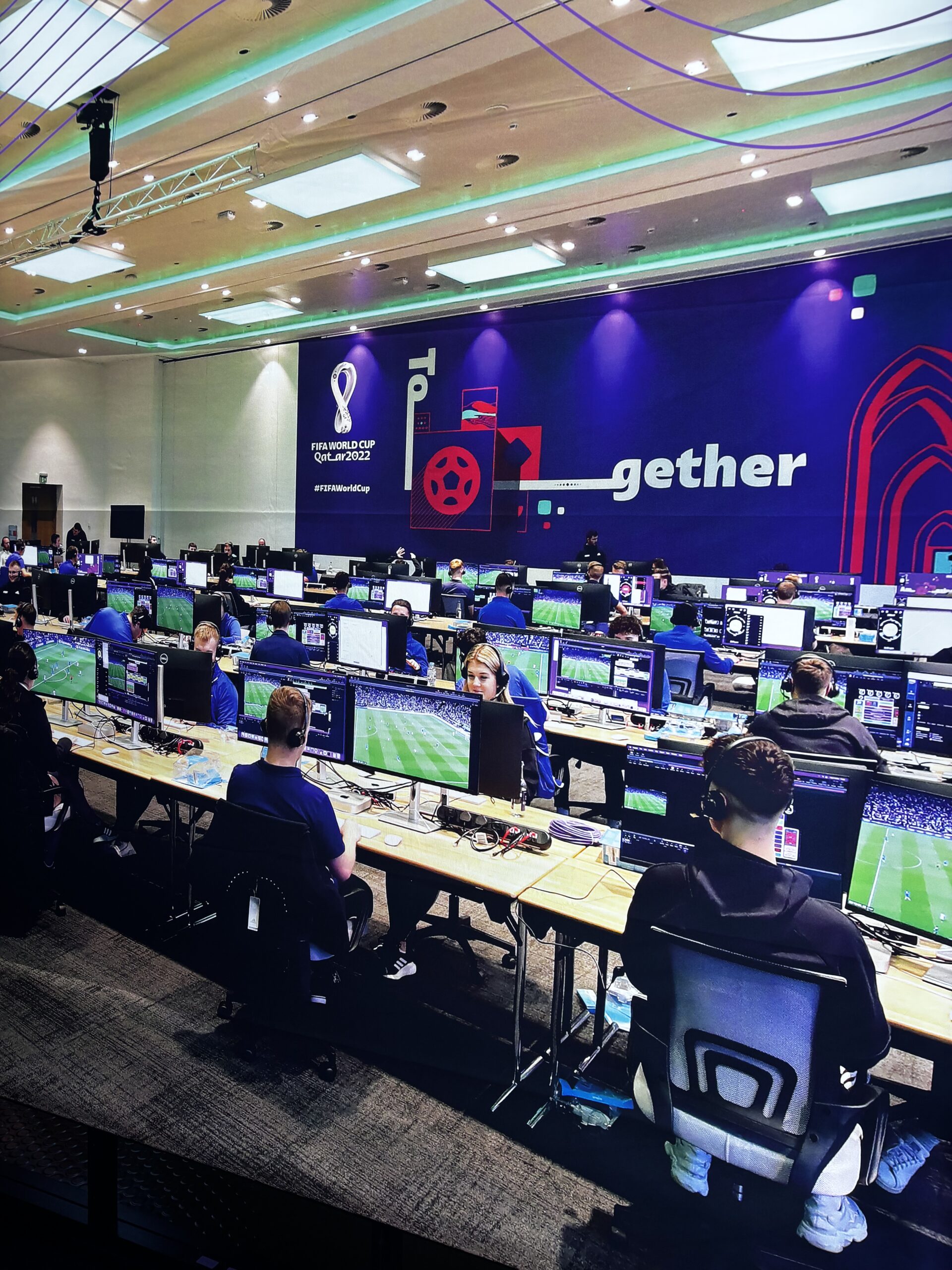
In Qatar for instance, at the 2022 FIFA World Cup, facial recognition for ticketing was only the tip of the proverbial digital iceberg: the country set up an Aspire Command and Control Centre in Doha that integrated feeds from a reported 15,000 security cameras across the 8 event stadiums to monitor fan behaviour. Justified as a way to ensure more “efficient” movement of crowds through stadium grounds, these systems can also target and police spectators.
The stakes of these “smart” stadiums are not only about policing and violence; they are reconfiguring the very terrain of politics. Not an isolated lab anymore, where something is tested once and released into the wild, the stadium becomes a primary site where Big Data is collected by multiple parties (FIFA, its sponsors, and local government) to further refine targeting and predictive algorithms.
Orit Halpern and Gökçe Gunel write of this move as a shift from the demos of democracy to the demos of the experiment: our ability to come together as a public, in public space, and negotiate governance – such as how corporations will target and shape consumer behaviour, or how policing is rolled out in certain neighbourhoods – become supplanted by the experimental tech that gathers data and continuously refines its algorithm, with a set risk tolerance for error. Politics and democracy are evacuated, replaced with the proprietary and black-boxed algorithm. The sports stadium is a crucial site for normalizing these new forms of techno-governance, ushering in heightened surveillance and control by taking advantage of our love for the Beautiful Game.
In the next post I turn to how this heightened surveillance and policing seeps out beyond the sports stadium to directly harm communities living in the surrounds. See you there!