
-by Carolyn Prouse
Algorithmic Policing Beyond the Stadium
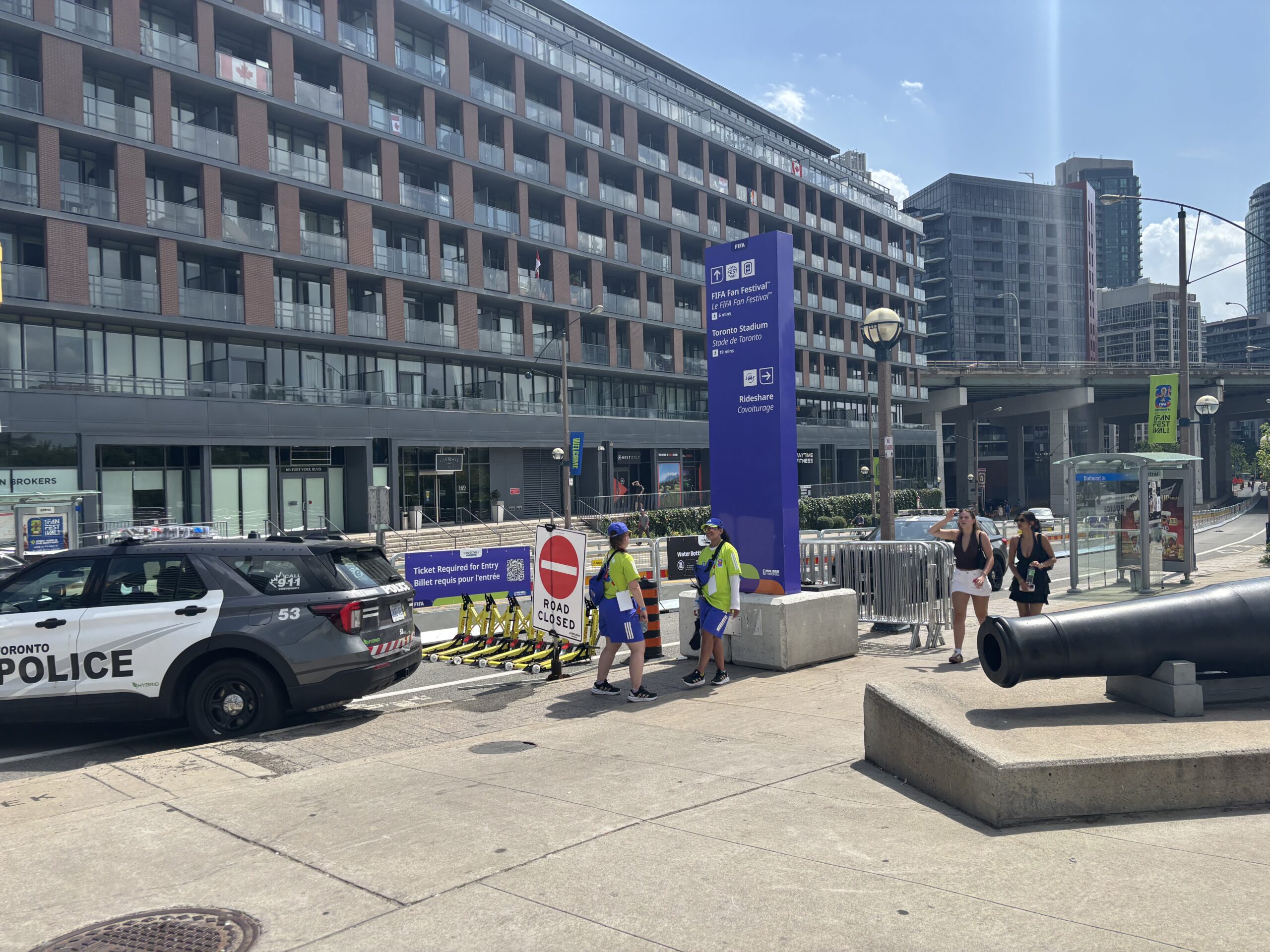
For the World Cup it is not just data but surveillance technology itself that seeps out of the sports stadium into its surrounds. In the first post for this series I discussed how digital technologies are mediating (and even harming) the game we love and, for the second, turned to how digital capitalism has also taken root in and through the sports stadium. In this final post I turn to those who are most adversely affected by the hosting of the World Cup and, especially, FIFA’s requirements for controlling and policing the 2km radius around tournament stadiums.
Through host city agreements, FIFA requires that municipalities create a ‘controlled area’ of a 2km radius around stadiums where people, businesses, and branding are placed under heightened control. A CBC article recently reported that in Vancouver, “roughly 200 cameras will be installed as part of a FIFA requirement in areas supporting World Cup-related activities, including B.C. Place, the FIFA Fan Festival at the PNE and training sites.” Organizers in Vancouver are particularly concerned because within this 2km radius lies the Downtown Eastside (DTES), often referred to as the poorest postal code in Canada, an area of the city already over surveilled and hyper-policed. While the city maintains these cameras will be removed after the FWC26, the long history of sport mega events is patterned with tech whose mission has ‘crept’ beyond its originary moment, becoming part of urban surveillance architecture from Los Angeles to Paris.
United States’ law provides more cause for concern in the areas around World Cup stadiums. The Los Angeles-based coalition NOlympics LA, writes of how the Department of Homeland Security declares sport mega events in the city (including the 2026, Super Bowl, the 2026 World Cup, and 2028 Olympics) ‘National Special Security Events’ (NSSEs). DHS deploys the NSSE designation for events that could be a “potential target for terrorism or other criminal activity” thus enabling a legal zonal security apparatus that “includes a hub of communications and intelligence gathering between local, state and federal law enforcement.” In other words, the NSSE draws the Department of Homeland Security (DHS), Immigration and Customs Enforcement (ICE), U.S. Customs and Border Protection (CBP), the Secret Service, the Federal Bureau of Investigation (FBI), state police, and Department of Defence into the city’s orbit.
And it is not just American security forces or techniques operating in these spaces. As NOlympics LA writes, Israeli companies such as International Security & Defense Systems (ISDS) have long trained security forces for sport mega events, with its own fascist boomerang where, “Israeli firms, at the direction of Israeli authorities, have taken the violence that they commit against Palestinians and exported it internationally for profit.”
In Mexico, too, heightened security is being rolled out in the three host cities of Mexico City, Monterrey, and Guadalupe, where close to 100,000 security personnel will take to the streets. Called “Plan Kukulkan,” the force will extend beyond host cities to include other popular tourist destinations through a force comprised of military, civilians, private security companies, and anti-drone systems. Robotic dogs– a K9-X unit – are rumoured to be joining the force to securitize BBVA stadium in Guadalupe, with “video cameras, night vision, and communication systems that are used to issue warnings or instructions.”
The dystopic visions of robot dogs and anti-drone surveillance domes are polarizing images that betray of something deeper: new types of digitally-based policing unrolled for the mega event. Many of police forces and systems across Canada, the US, and Mexico are already engaged in algorithmic policing – concerning techniques that embed bias, privatize data, and enroll everyone in dragnet forms of surveillance. Digitally-based policing is now receiving heightened financing and legitimation through the bloated security budgets of World Cup host governments. Citizen Lab in Canada has documented the use of algorithmic policing by the Vancouver Police Department, while Toronto is unleashing a new Counter-Terrorism Security Unit that shares “intelligence” with other forces in Canada. And Canada’s Department of Defence has just come under fire for a new deal inked with notorious data analytics firm Palantir. Meanwhile, municipal policing strategies to protect FIFA’s World Cup are rolling out across the United States, with the FBI announcing recently a centralized intelligence gathering system to analyze data about potential terrorist threats. These programs are not new – indeed, policing across North America has for the last decade has been dabbling with data-intensive crime prediction software and protocols. What the World Cup provides is an incentive for ramping up these systems that naturalize militarized policing, funnel data and profit to private firms, and black box and supplant democracy with algorithmic decision-making.
The Beautiful Game Beyond Fortress FIFA
In spite of proliferating “smartness,” sporting stadiums can be profoundly moving. Just as they’ve been the staging grounds to gather fascist youth, or to celebrate military flyovers, stadiums also collectively move spectators into a fervour. A sudden roar that pulls you, unmoored, from your seat. A sharp intake of breath from all sides when a ball almost crosses the goal line. There is a beauty to the collective spirit that inhabits bodies when pulled together. Beauty can turn ugly, of course. But the stadium provides one of those rare spaces at our contemporary moment of digital numbing: being in person, together, even in privatized space. Technofascism – in the form of surveillance for racialized policing, of carving up our bodies and attention spans, of compiling, monitoring, and nudging our behaviours for predatory market logics – rip these visceralities from us and from our ability to build the demos. Is a democratic election going to pour out of a football stadium match? Probably not. But we can and should demand transparency and control over the technology that is mediating our interaction with The Beautiful Game and with each other.