
-Carolyn Prouse
FIFA has rightly made headlines for the oligarchy’s cozy relationship with authoritarian and fascist regimes. The evolving fraternity between FIFA President Gianni Infantino and American President Donald Trump, from the Oval Office to the (macabre) FIFA Peace Prize presentation and Infantino’s presence at the Israel-Gaza ceasefire talks, is only the most recent example of FIFA’s proclivity for near- or real dictatorships. FIFA has happily worked with authoritarian governments in Italy (1934), Argentina (1978), Qatar (2022), the United States of America (2026), and Saudi Arabia (2034). Nick McGeehan of Fairsquare sums up the stakes when he notes, “FIFA is fast becoming a handmaiden to the authoritarians reshaping a bleak new world order.”
Terms like fascism and authoritarianism have come to dominate left-leaning media, and for good reason. Trump’s authoritarian tendencies echo moves to the far-right by other so-called democratic governments from India to Brazil, which position religious, caste, racial and gender minorities as threats to the body politic.
Amidst this upsurge, and building on a long line of Black studies scholarship from Walter Rodney to Angela Davis, philosopher Alberto Toscano argues in his book Late Fascism that fascism cannot be confined to inter-war Europe. Italian and German fascism was first trialed in the colonies and “boomeranged”, as Aimé Césaire writes, back to Europe; and the state has always had fascist tendencies towards Indigenous and black people in settler colonies like Canada and the US where, as Harsha Walia posted on BlueSky, there never was a boomerang. If we see fascism, as Toscano does, as “a set of repressive tactics [and] an encompassing political and ideological process, which differentially targets racialized and subaltern populations whose very existence and sociality are perceived as a threat” (p. 35), then fascism has always been the underside of democratic liberalism.
At the same time, scholars and journalists have been turning to the notion of “technofascism” to characterize the current fascist moment, where governments rely on technology, Big Tech companies, and technocrats (see Elon) to drive political division and hate. Writers are using the term to show how the use of digitally-driven technologies (of which AI is only the latest frontier) can enable fascist violence through augmenting racial hatred, fear, and political polarization. Technofascism is alive when ICE uses data from private surveillance cameras; when social media algorithms amplify hate messages about minority religious and ethnic groups; and when police forces use third party AI platforms such as Palantir’s Gotham to predict when and where crime will occur. Fascism, in the Big Data and digital age, is driven, as Mark Coeckelbergh puts it, by “data extraction, algorithmic governance, behavioral nudging, and platform monopolization.”
But just as fascism has a long shadow outside the very specific violences of the inter-war period in Europe – in the colonies and in the everyday infrastructures of the liberal democratic state – so too does technofascism wind its way through histories of state violence.
And sport – including and especially hypervisible, nationalist-driven sport mega events – provide the political will, financial dollars, and patriotic fervour to test out and entrench technologies, from advanced AI to mechanical bullets, that sow the division upon which fascism is built. In other words, a slice of the long shadow of (techno)fascism resides in the sport stadium: in the sporting technologies that bring us the athletes and the game, and in the technologies that secure the field and venues of sporting action. The FIFA World Cup is only one testbed for such experimental technologies, but it is one of the most ostentatious and lucrative, and it is one for which many people consent.
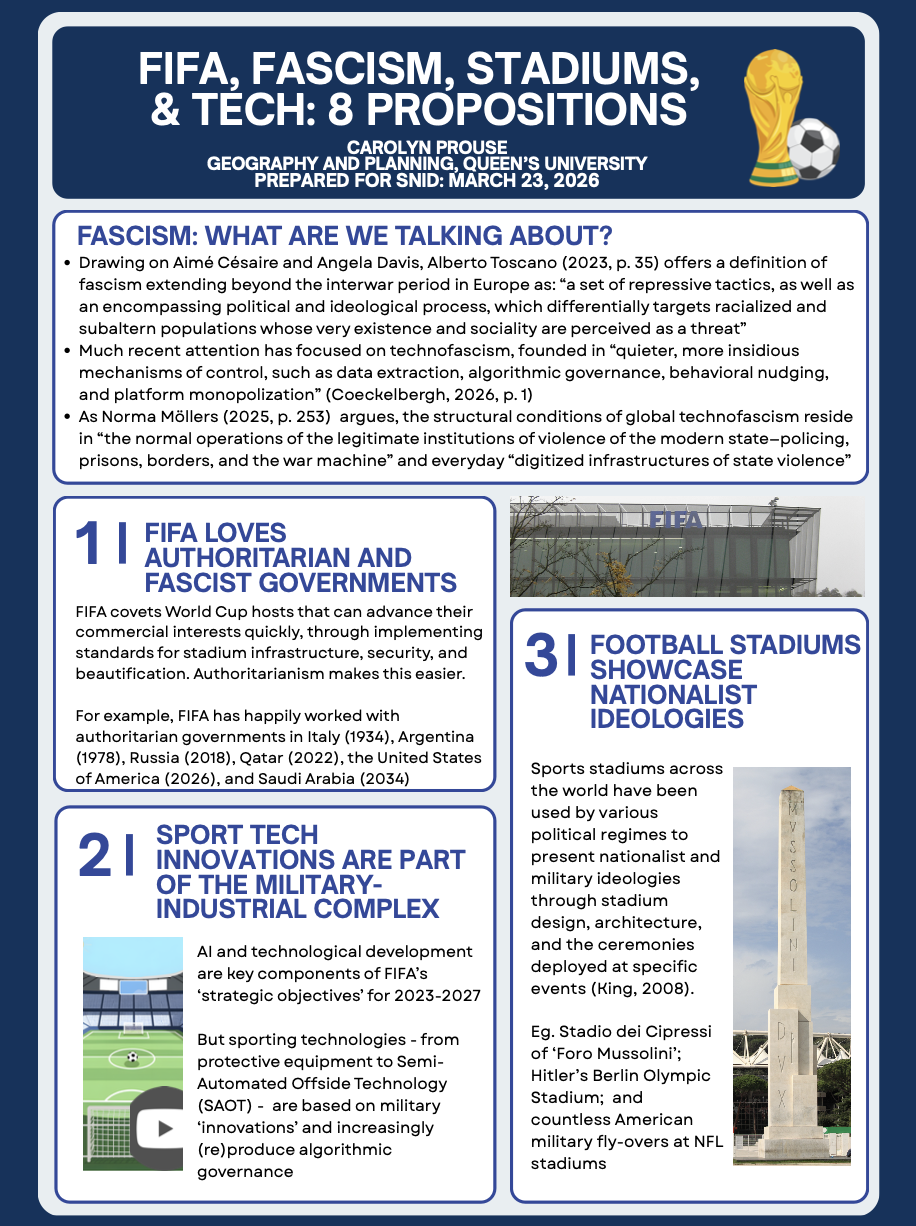
For a recent conversation I facilitated at Queen’s University about fascism and the FIFA World Cup 2026 (FWC26), I created an infographic that lays out some of the fascist tendencies underpinning sport mega events. My present-day concern with fascism emerges from the authoritarian displays I highlighted above, but also from one of my long-standing research agendas: to understand the dispossessing and policing logics of sport mega events, especially the World Cup. From the 2010 tournament in South Africa, where FIFA strong-armed stadium infrastructure for ‘beautification’ standards, to the 2014 rendition in Brazil, where the state set up permanent military police units in low-income favelas to help ‘securitize’ the tournament, I’ve traced many of the violent underpinnings of the FWC26. Now that the World Cup has come to my hometown (Toronto) and the city where I spent many years undertaking a PhD (Vancouver), I’ve been considering how the tournament reproduces (techno)fascism in ways both old and new.
This pamphlet lays out some major propositions about the relationship between the World Cup and fascism, building on much scholarship in the field of socio-cultural studies of sport. There are more(!), but the eight I focus on here include:
- FIFA loves authoritarian and fascist governments
- Sport tech innovations are part of the military-industrial complex
- Football stadiums showcase nationalist ideologies
- The digitized ‘fan experience’ transforms us into experimental, consumer, and surveilled subjects
- World Cups exacerbate long-standing fascist, policing, security, and surveillance state systems
- World Cups are ‘zones of exception’ that suspend the ‘regular’ functioning of law
- Immigration and border concerns are augmented by this event being hosted across three countries
- Communities have always resisted fascism and sport mega events.
I hope to offer a series of blog posts that further develop some of these ideas.
Click here for PDF version of the pamphlet.