
by Jair Coronado Rosales
Mega-events such as the FIFA World Cup are unique phenomena in the history of certain countries, as well as certain cities. These scenarios open up opportunities for various transformations, particularly in relation to the urban environment and its infrastructure (Klinenberg, 2021; La Duke and Cowen, 2020). However, there are also transformations that go beyond the material, the physical, and the economic; transformations that occur in the intangible realm, where the loss of elements that are at risk amid such upheaval can have an immeasurable cost in terms of identity, memory, and history.
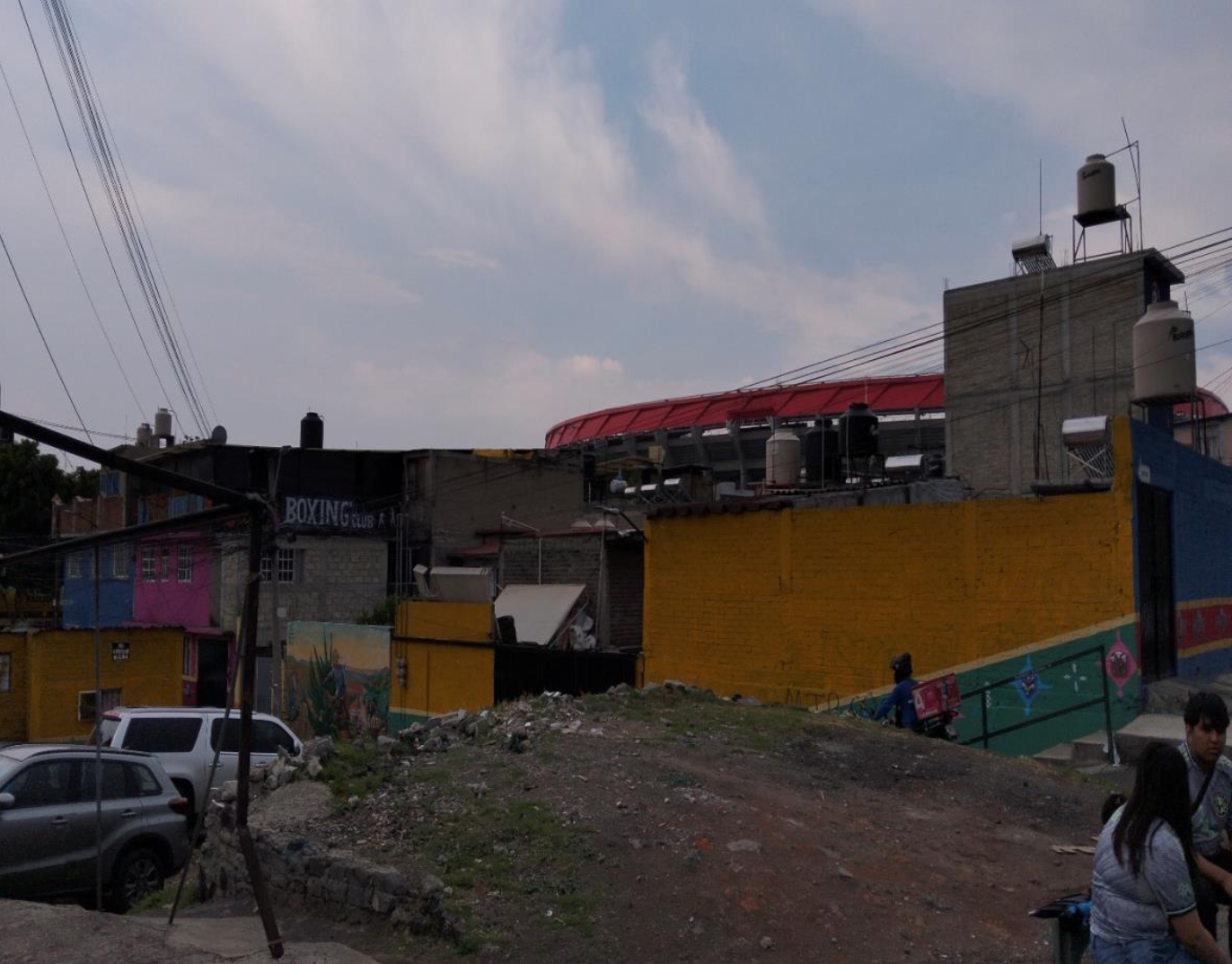
Mexico City will participate in its third World Cup. The Azteca Stadium (now Banorte) will be the only stadium in the world and in the history of soccer to have hosted three World Cups to date, its second already in the neoliberal era, 1986 and 2026. In this regard, it is important to consider the impacts of hosting a mega-event like the 2026 FIFA World Cup, not only because of what happens in Mexico City, but also because of what happens in an area adjacent to the stadium, a working-class neighborhood, a marginalized space, known as Pedregal de Santa Úrsula Coapa (PSUC).
The urban transformations that have been taking place in Mexico City over the past two years under the pretext of the 2026 FIFA World Cup have reached such a level of hostility and imposition that certain sectors of the population have expressed their dissatisfaction. This is evident, to mention just one example, in the fight against the “La Gran Tenochtitlán” bike lane on Calzada de Tlalpan by the sex workers who occupy this space, who have argued that this imposition has been used to implement social cleansing practices under the pretext of the World Cup.
The remodeling taking place at Azteca Stadium and its surroundings has also been highly controversial regarding the natural resources required and extracted in the process, such as water. The town of Santa Úrsula Coapa, located next to both the stadium and the working-class neighborhood of PSUC, has historically fought for its right to water as an indigenous community of Mexico City, and has taken a stand not only against the 2026 FIFA World Cup but also against the advance of gentrification in the city and the social, historical, and cultural problems that arise from this kind of urbanization characteristic of the neoliberalism in which we live (Brown, 2020; Gago, 2015). However, there is an impact that fundamentally transgresses the configuration of the identity and memory of the people living in the PSUC neighborhood: the re-dynamization of the Azteca Stadium’s functions, as a megaproject and infrastructure, perpetuates the commodification of land, landscape, and urban culture in Mexico City.
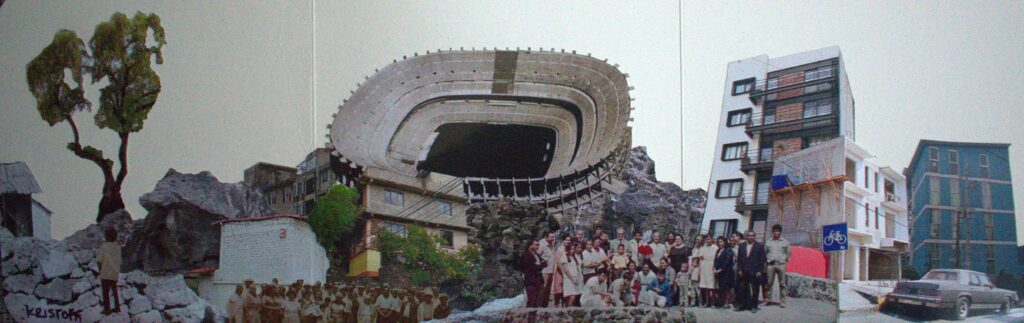
– Triptych of a Shared History (2025). Created by Kristoff. Analog collage.
The Azteca Stadium has become a point of reference not only in terms of location, but also as a symbol of identity for the people living in the neighborhood, particularly those who live on the streets closest to the stadium. This is thanks to the shared history between the stadium and the neighborhood, a history that takes us back to 1962, when the two first intersected, when the stadium began to be built at the expense of a neighborhood that already had life, that had already been developing for years, and even had precariously built houses on the land where the Azteca Stadium now stands.
We must stop to think about these years before the stadium’s construction, years in which people were already spending their time not only building their homes, but also a future, on rocky ground, on the outskirts of a town, “far from civilization.” It turns out that this period is more significant than it appears, but, unfortunately, it is what may be on the verge of being lost as urban, capitalist, and neoliberal transformations intensify, re-dynamized by mega-events such as the 2026 FIFA World Cup. This brief period of time, roughly 10 years, from 1950 to 1962, constitutes the ideological, identity-forming, and material foundations upon which a working-class neighborhood was built.
The purpose of this paper is to examine the current state of the PSUC neighborhood during the preparations for the 2026 FIFA World Cup. On the one hand, it aims to analyze or reflect on the transformations that are still taking place today, what they are in response to, but above all, to delve into what these transformations entail in terms of their transgression of the memory and identity of the people who inhabit the neighborhood. On the other hand, it also seeks to conduct a historical and spatial comparison of this current situation against a past that remains in resistance not only through memory, social practices, and traditions, but also through the people who participated in and formed part of what the neighborhood has historically been, people who experienced both its construction and its gradual transformation over the years in relation to Azteca Stadium.
For this historical and spatial comparison, I will draw on interviews I have conducted over the past three years with people who live in the neighborhood, including older adults over the age of 75 and younger people under the age of 50. As Gayatri Spivak (2003, 2007) rightly points out, it is important to recover the voices of subalternized people, those voices that have been silenced due to their proximity to a stadium, a megaproject, an urban infrastructure.
It is crucial to undertake this exercise, as it has become a historical necessity to reclaim a sense of who we are, of what constitutes us not only as individuals but as a community, a social and spatial formation, in this case, what has shaped and constituted the PSUC neighborhood, everything that is at risk of being lost amid so much transformation, but above all, amid the disposability imposed upon the neighborhood, the town, and other surrounding working-class spaces as a result of mega-events such as the FIFA World Cup 2026.
Read the full study in Spanish here: